
Drift vs Design
A central idea from my book SuperSkills

Now accepting keynotes for Q4 2025 / Q1 2026
The SuperSkills Era: a 60-minute session for leadership teams, a practical framework on building human capability that thrives alongside AI. Research-backed. Immediately actionable. In person or virtual. UK, Europe, global.
→ Book a discovery call | → Explore: thesuperskills.com
In addition to this newsletter, I recommend a few others. All free. Check them out here.

Friends,
Most people sense that something in modern life has slipped out of their hands.
Not in a dramatic way.
More like a gradual erosion.
A collection of small decisions that no longer feel like decisions.
We live inside systems that anticipate our next move.
Streams decide what we watch.
Maps decide how we travel.
Platforms decide what deserves our attention.
Calendars decide the shape of our days.
None of these choices disappeared.
They simply moved into the background.
This is what I call Drift.
Drift is not laziness.
It is what happens when the world is built to reduce friction.
The smoother the path, the less we notice we are following it.
People respond to this environment in different ways, depending on two key factors: whether they notice what is happening and whether they can take action based on their observations.
To understand these patterns, I use a framework from my book called the Drift vs Design Matrix.
It maps human behaviour across two dimensions.
Awareness is the ability to recognise when systems are shaping your choices.
It is the capacity to see the defaults, algorithms, and patterns that guide your attention.
Agency is the capacity to act on that recognition.
It is the ability to adjust, refuse, or redesign the structures around you.
Together, these create four distinct ways of living with technology.
The Drift vs Design Matrix
High Awareness, Low Agency: The Stuck
They see the patterns but cannot break them.
High Awareness, High Agency: The Designers
They see the systems and shape them.
Low Awareness, Low Agency: The Sleepwalkers
They do not notice the drift.
Low Awareness, High Agency: The Programmed
They optimise without questioning.
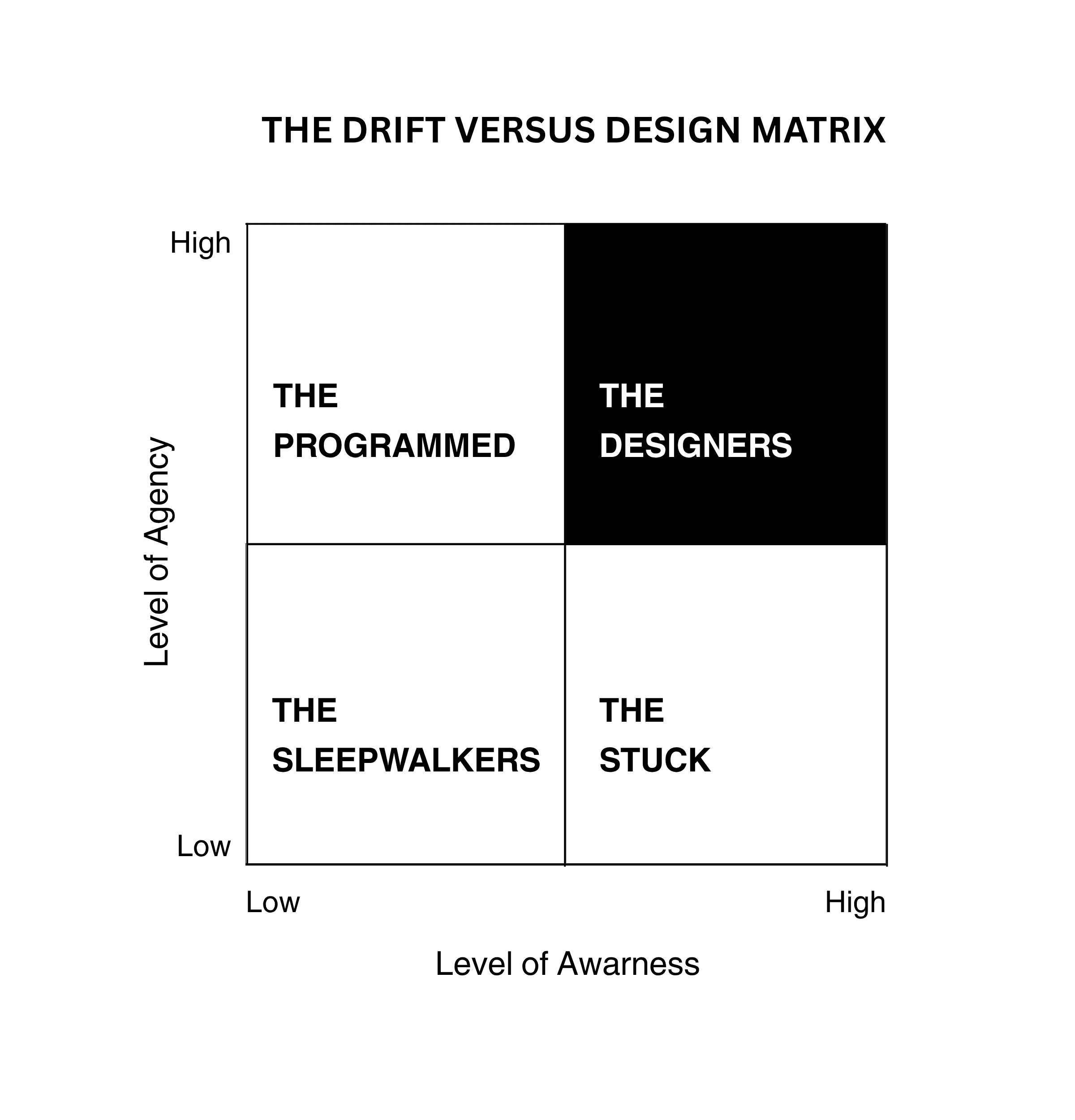
These four patterns appear in the wider environment we all live in.
For example, take the morning phone reach.
Before you are fully awake, your hand moves.
Eyes unfocused, thumb scrolling.
That first reflex is more physical than cognitive.
It shows how deeply technology has settled into the nervous system.
You have not chosen anything yet.
You are already reacting.
Or look at Google Calendar.
Thirty or sixty minutes.
Two neat blocks chosen for screen clarity, not human rhythm.
Yet entire organisations now shape their days around them.
On Spotify, ninety per cent of listening comes from algorithmic suggestions.
What feels like taste is often a loop built from your past behaviour.
These patterns form the environment in which the four responses emerge.
Low awareness, low agency: The Sleepwalkers
Sleepwalkers do not experience the day as a series of decisions.
Attention flows to whatever surfaces next.
Apps lead.
Interfaces steer.
Autoplay and alerts set the tempo.
They are not disengaged.
They are saturated.
Hours fill up without a sense of ownership.
High awareness, low agency: The Stuck
The Stuck recognise the drift.
They see how often they react rather than choose.
They understand the patterns, but cannot change them.
Many describe a familiar sensation.
A small tightening in the chest when they open their inbox.
Not from urgency, but from the feeling that the day has already been shaped before they arrive.
Notifications return even after they are turned off.
Apps reappear even after they are deleted.
Awareness becomes tension rather than action.
Low awareness, high agency: The Programmed
The Programmed perform well inside the systems they inhabit.
Their calendars run precisely.
Their processes stay sharp.
Their tools are mastered.
But they rarely question the structure itself.
A consultant may automate reporting, colour-code their week, and use AI to summarise everything, yet never pause to ask whether the project solves anything real.
A founder may perfect their operations and still drift away from the purpose that started their work.
They are capable, yet operating within constraints they did not choose.
High awareness, high agency: The Designers
Designers are defined by authorship rather than productivity.
They understand how tools influence behaviour, and they adjust rather than absorb.
They do not reject technology.
They use it in ways that support what matters.
A Designer checks their phone when fully awake, not because of a rule, but because they want the first thought of the day to be their own.
They navigate partly by memory, partly by map, because orientation is a skill worth protecting.
They let algorithms assist, not define.
They choose which prompts to accept and which to let pass.
Their life is not perfectly arranged.
It is consciously arranged.
There was an evening not long ago…
I caught myself checking emails at the dinner table.
Nothing urgent.
Nothing important.
My hand moved before I realised it.
A notification lit up and pulled me in.
One tap became three.
Three became a search.
The search turned into an odd Amazon and AliExpress cul-de-sac.
Ten minutes of scrolling through things I did not want, could not justify, and had no business looking at.
The strange part was not the content.
It was the momentum.
Something that felt personal enough for me to treat it as a priority, even though my family were sitting right there.
No one asked me to look.
No one needed me.
It was drift expressed as muscle memory.
The reflex arrived before the intention.
The same pattern shows up in other quiet moments.
A morning when Spotify served a track that matched my mood perfectly. Helpful at first, then unsettling. If the system knows the contours of my mood, what happens to the part of me that used to explore?
Even the headphones play a role.
On my morning walks I listen to podcasts without thinking. Efficient. especially at 1.5x, yes. Useful, yes.
But on the days I forget them, the quiet feels unfamiliar, then grounding.
I hear the birds, the air, the city waking.
And I realise how long it had been since I noticed any of it.
None of this is dramatic.
That is the point.
Drift hides in the reflexes.
I am not outside this.
I am inside it too.
A day in drift. A day in design.
Imagine the same person on two different days.
On the first, they reach for the phone before their eyes have opened.
They move from message to feed to task.
The morning becomes reactive.
The commute becomes a blue line.
Work becomes a sequence of replies.
By evening, they have completed many tasks and made few decisions that felt like their own.
On the second, they pause for five minutes before touching a device.
They sit up slowly.
They ask what the day is about.
On the commute, they navigate most of the journey from memory and use Maps only to confirm timing.
At work, they choose what matters rather than letting the inbox decide.
The difference is not discipline.
It is awareness multiplied by agency.
Drift compounds quietly.
Design compounds too.
Why the stakes are rising
Earlier technologies shaped behaviour, but their influence was broad and blunt.
Television broadcasts the same message to everyone.
Books shaped thought, but slowly and in one direction.
AI behaves differently.
It learns from each person individually.
It adapts in real time.
It builds a model of your habits and feeds them back to you.
This creates a loop:
Repeat a behaviour, the system notices.
The system reinforces it, you repeat it again.
The loop strengthens.
Drift becomes self-reinforcing.
Design becomes self-amplifying.
This is why awareness and agency matter more now.
The tools are dynamic.
They respond to you and shape you simultaneously.
From diagnosis to design
Design begins when the automatic becomes visible.
Once these patterns come into view, even the smallest choices take on a different quality.
The phone in the morning.
The route you take.
The content you consume.
The way you decide what matters.
The matrix is a diagnostic tool.
It shows you where you are.
What you do with that awareness is the work of design.
And once something becomes visible, it is difficult to ignore.
Stay Curious - and don’t forget to be amazing,
Rahim Hirji Author, SuperSkills (2026) | Keynote Speaker | Advisor
Building human capability for the AI era.
Tools I Use:
Refind: AI-curated Brain Food delivered daily
Meco: Newsletter reader outside your inbox
Prompt Cowboy: Prompt Generator
Genspark: AI Super Agent
Blotato: All-in-one Content Workspace
Recommend Reading:
Now
How to be creative (without taking drugs)
No substances required.
Company Run Almost Entirely by AI-Generated Employees Descends Into Chaos
“They’d basically talked themselves to death.”
Soy, oat, almond, rice: which alternative milk is healthiest? The best choice depends on your needs and preferences, say experts – here’s how to pick the one for your lifestyle
A.I. Cheating Rattles Top Universities in South Korea
As many elite colleges struggle to adapt to the technology, the nation’s most prestigious universities said dozens of students used artificial intelligence tools to cheat.
Meet Type 1.5 Diabetes—the Overlooked Condition More Common in People Over 30. It can look like type 2 diabetes, but it’s an autoimmune disease that eventually requires insulin.
Next
Meta is about to start grading workers on their AI skills. Meta will assess employee performance by AI-driven impact starting in 2026. The company is shifting toward an AI-native culture and incentivizing AI adoption through rewards.
What happens to the weavers? Lessons for AI from the Industrial Revolution
Handled right, AI has potential to bring back middle-skill jobs lost to the rise of computers, economists argue. Or, like the mechanized mills of the past, it could toss whole sectors out of work.
An Economist Asked, How Much Should We Spend to Avoid the A.I. Apocalypse?
The question “at first struck me as too open-ended to be usefully addressed by standard economics,” said Charles Jones of Stanford. He took a shot anyway.
OpenAI walks a tricky tightrope with GPT-5.1’s eight new personalities
New controls attempt to please critics on both sides with a balance between bland and habit-forming.
Meta Ray-Ban Display Review: First Generation Heads-Up Mobile Computing
If you enjoyed this edition of Box of Amazing, please forward it to a friend or share the link on WhatsApp or LinkedIn.