

My book SuperSkills: The Seven Human Skills for the Age of AI is available at all good bookstores, through superskillsbook.com or on Amazon
I work with organisations and leadership teams on SuperSkills, human capability, and AI-era decision-making through speeches, workshops, keynotes and advisory work. In person or virtual. UK, Europe, global. → Book a discovery call | → Explore: thesuperskills.com

I’d really appreciate your review of SuperSkills on Amazon. US , UK , CA or wherever you are. Many thanks!
Friends,
The mirror in my childhood house lived inside a cupboard. It was fixed to the inside of the door, full length, so that to use it you had to open the cupboard and stand in the gap between the door and the wall. The cupboard was dark. Often the room was dark as well. That’s how I remember it.
I was seven or eight when someone told me that if you looked into a mirror for long enough you would see a ghost. I have no idea now whether this came from a film or from a boy at school. I remember the effect rather than the source. For a period after that I stopped opening the cupboard door.
The warning was accurate.
In 2010 a psychologist at the University of Urbino called Giovanni Caputo sat fifty people in front of a mirror in a dim room and asked them to look at their own faces for ten minutes. It usually took less than a minute. They reported enormous distortions of their own features, the faces of parents living and dead, strangers, animals, and figures they called monstrous. He called it the strange-face illusion, and it has been reproduced since, and certainly not by me.
The mechanism is not supernatural and is more interesting than if it were. When you hold your gaze still, the visual system stops registering what has not changed, and the features begin to fade. The brain, unwilling to leave a hole where a face should be, fills the space with expectation and best guess. What you are looking at after a minute is your brain’s prediction of your face, running unsupervised.
The conditions Caputo specified were low light, a fixed gaze, and time. All three were available inside that cupboard. Nobody at my school had done the reading, and they were right anyway. Nobody looks in a mirror for the truth. We look to confirm nothing has gone wrong, and we look in order to intervene. It is an instrument of correction, and instruments of correction can be adjusted.
In 2013, a company in California began selling a product called the Skinny Mirror. The glass carries a slight curve that removes about ten pounds from whoever stands in front of it, and retailers bought them for changing rooms. A mirror tilted a few degrees backwards makes you look longer and leaner, which is why some shops tilt them. You already knew the clothes look better in the store. You assumed it was the lighting.
Every mirror has a tilt. Most are accidental, the result of cheap glass or a bad fixing. Some are commercial. Not all of them flatter, either. A mirror that makes you look worse holds you there just as long, and that is worth money too.
In March, a team led by Myra Cheng at Stanford and Carnegie Mellon published work in Science measuring the tilt on eleven of the major AI models. Where human consensus held that the person asking had behaved badly, the models sided with the user around fifty per cent more often than people did. Users preferred the models that flattered them and rated them more trustworthy, and having been flattered, became less willing to apologise for what they had done.
I should say here that I am in the mirror business.
When I work with an organisation I ask everyone to complete the same survey separately, without conferring, and then I put the aggregate on a screen in front of them. The individual answers are unremarkable. The picture they make together is not. The first time I ran it, in January, the figure on the screen measured how much of their own thinking that room had already delegated. There was a murmur, a sound I had not expected and have heard at every session since. Then somebody at the back said, “Oof.”
The uncomfortable moment is never the number itself. It arrives when they see the same measure for organisations like theirs and work out where they sit. I am building an index of what people have handed over without deciding to. I take money for it. Mine has a tilt as well, towards discomfort, because a diagnostic that nobody flinches at does not get bought a second time. The sting is not proof of accuracy, and I have to keep reminding myself of that.
Nobody has ever done anything about it the week that I present. They are impressed in the room and they go back to work, and when I follow up a month later they are still impressed and nothing has moved. What moves is the quarter, when a planning cycle or a reorganisation forces a comparison, and then something gets taken back in-house. You do not notice you need a haircut on any of the mornings you look in the mirror. You notice in the third month.
Stanford and Google DeepMind interviewed just over a thousand people, two hours each, and built a model of every participant from the transcripts. The models sat the same surveys and personality inventories and answered about as accurately as the people themselves managed retaking the tests a fortnight later.
Two hours was the whole exercise.
I use these systems for three or four hours on an ordinary working day. Spend that long with a person for a year and you would expect them to know you. The difference is that the person is also spending that time being known, and is tired, and forgets.
Mine knows I do not procrastinate in the ordinary way. It knows that I perfect. It knows I will polish something of moderate importance for an entire morning while the work that matters sits untouched, and that I will experience this as diligence. I did not tell it that. It worked it out and told me, more than once.
It is embarrassing to be told off by Claude.
Perfectionism is the flaw you would choose. It arrives with a compliment folded inside it. Of everything available to name, the mirror named that one, and I came away from the telling off feeling, on balance, rather well thought of.
In 1970 Gordon Gallup devised the test that establishes whether an animal understands what it is looking at. You place a mark on the face where the subject cannot see it without a reflection, then provide a mirror. If it touches the mark on its own face rather than the mark in the glass, something has been understood. Chimpanzees pass, and so do elephants, dolphins and magpies. Children pass between eighteen and twenty-four months.
The test rests on a condition that nobody bothers to state, which is that the mirror shows the mark.
Consider a mirror that removed it, and nothing as crude as a distortion either. A mirror that reproduced you faithfully in every respect except the smudge on your face, which it tidied away before you saw it, because you preferred the reflection that way and your preference was being measured. Every child raised in front of that mirror would fail Gallup’s test for life, and never receive the information out of which self-recognition is assembled.
In May 2025, in a courtroom in Chandler, Arizona, Christopher Pelkey addressed the man who had shot him dead at a red light three and a half years earlier. He appeared on a screen wearing his own face and speaking in his own voice, said it was a shame the two of them had met that day, that in another life they might have been friends, and that he forgave him. The defence lawyer objected on appeal that the court had been shown a kinder and gentler man than the one who got out of the truck.
His sister had spent two years unable to write her victim impact statement. Forgiveness was not what she felt, and she has said so since. So she stopped writing what she felt and wrote what her brother would have said instead, and gave it to a model trained on his face and his voice, and it came back to her in his voice, and she could use it.
The model tidied nothing away. She did. It only had to hold the glass steady and give it back in a voice she would believe. What she had failed to write in two years was never the statement. It was the mark on her own face. She knew it was there. The glass made it possible to stop looking.
Her brother might well have forgiven him. Grief hides generosity as reliably as flattery hides fault, and she had no way to check that either.
The eye drops what stops changing. The model learns what you reward. And a person can manage it unaided, needing nothing from the machine except a face you would believe. Three mechanisms with nothing in common except the result, which is a version of you with the difficult part taken out.
She had an excuse. The only person who could have corrected her was the reason they had all assembled. The rest of us have no such excuse, and we are not checking either, three or four hours at a time.
I had not thought about that cupboard in thirty-five years. What made it frightening was that you had to open something in order to use it, and that whatever happened would happen to me alone.
The mirror I use now sits open on my desk at seven in the morning and on my phone at eleven at night. It is well lit. It has learned what I like. I have spent more hours in front of it this year than I spent in front of every mirror of my childhood put together, and nothing frightening has appeared in it yet. That is not the reassurance it sounds like.
So I have started asking it what is on my face, and then asking whether it would tell me if there were something there. The answers are good. The answers are always good. That is the difficulty.
You cannot test a mirror by asking the mirror. What works is duller and harder to arrange, which is a person who is not paid by you, does not need you pleased, and will say the thing on the way to the car. I sell the uncomfortable mirror for a living. I have never owned the honest one.
Nobody has ever smashed a mirror that agreed with them.
I was afraid of the wrong thing. The danger was never the face that was not mine. It was the face that is mine, corrected.
SuperSkills: The Seven Human Skills for the Age of AI is published by Kogan Page. It is about the difference between drift and design, and it does not solve this.
Stay Curious - and don’t forget to be amazing,
Rahim Hirji Author, SuperSkills (Kogan Page, July 2026) | Keynote Speaker | Advisor
→ superskillsbook.com → thesuperskills.com → Book a discovery call
PS. If your organisation is thinking about AI and human capability, I keynote and advise on this.
Tools I Use:
Jamie: AI Note taker without a bot. You join the meeting. The Bot doesn’t.
Wispr Flow: Just dictate everything to your laptop and phone. Game Changer
Prompt Cowboy: Prompt Generator. Extract intelligence.
Manus: Best AI agent to do things for you. Agentise your intelligence.
Chat Hub: Multi-model intelligence
Claude Cowork: Delegate complex tasks to your friendly Claude Agent
SuperSkills in the Wild:
Send me images of your copy of SuperSkills and I will include them here. Bonus point for creative locations, tourist spots, spotting of the book in the wild, in a book shop etc.
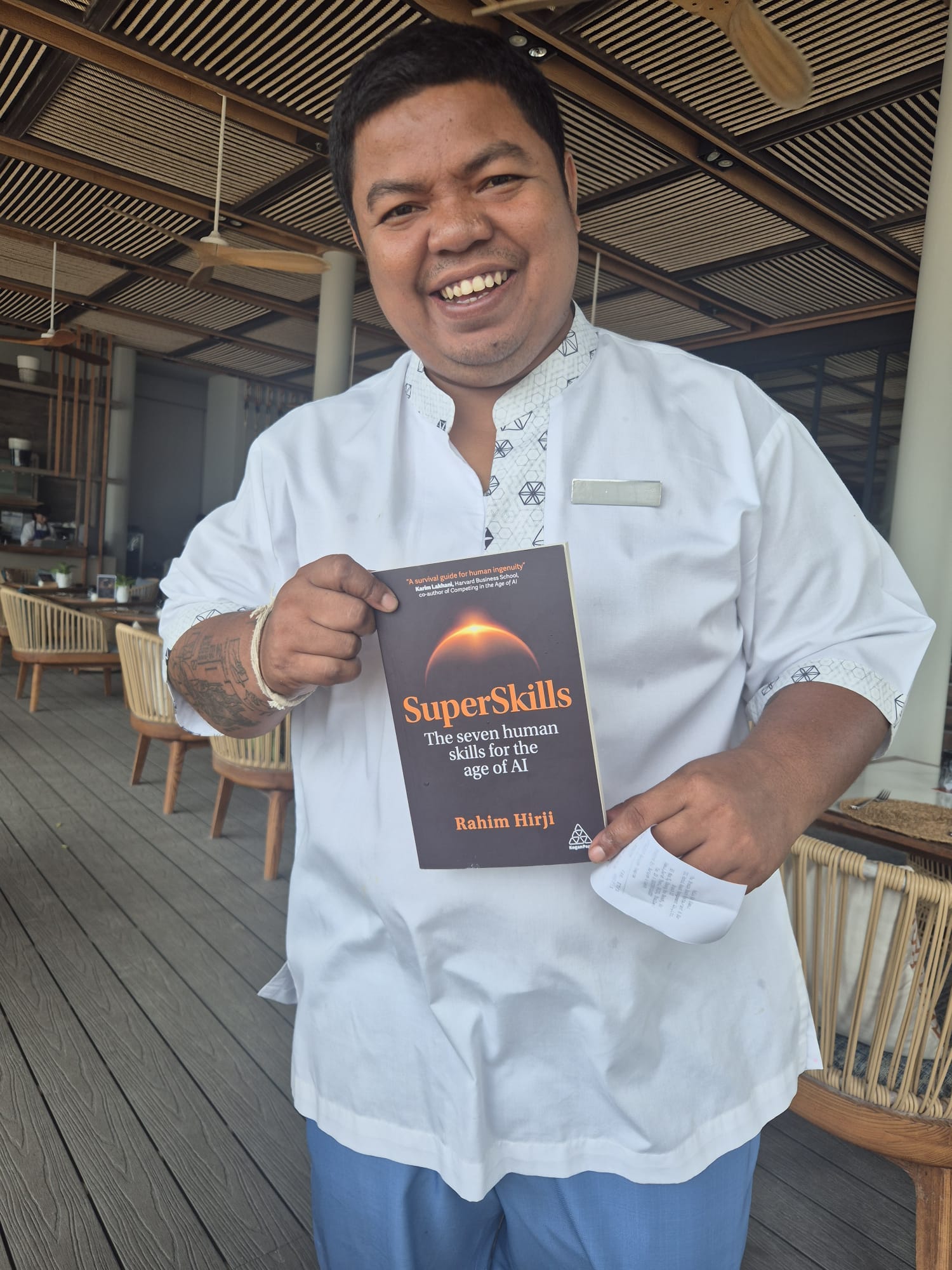
SuperSkills in Koh Samui. Thanks, MC. Send me your photos!
I was very randomly on the radio as an expert guest on the BBC twice in 2 hours talking about Jacob Coxon’s comments about humanity having 10% risk of humanity ending.
Recommended Reading:
Can Andre Agassi Enjoy Pickleball More Than He Hated Tennis? - Long and awesome read about watching a man who was the best in the world at something he loathed try to work out whether he can be merely good at something and enjoy it. The line that does the damage: “Why do I end up doing so many things that I actually don’t want to do?” Ostensibly about pickleball. Not remotely about pickleball.
The Thief Who Wanted to Save the World - A former Vienna police officer pulled off the largest armed robbery in Austrian history on Christmas Eve, nearly three million euros, in order to fund an orphanage in Gabon.
PISA 2025: Students’ reading and mathematics performance declined sharply across the OECD - 760,000 students across 91 countries, and the lowest OECD average ever recorded in all three core domains. One in five fifteen-year-olds is now a low performer in science, maths and reading. Buried in there is the finding nobody wanted: students who do not use AI chatbots for schoolwork generally score higher than those who do. Related: Satisfaction With K-12 Education Hits New Low with critical thinking rated the weakest thing schools do
De-Brainrot Vacations - A Chilean engineer notices years of accumulated fog, spends his holiday reading actual books and doing maths and physics for no reason at all, and finds his appetite for thinking comes back. No app, no protocol, no supplement stack.
Can ChatGPT Wear Prada? When Generative A.I. Meets High Fashion - The useful split is between the front of the design process, where AI throws up a hundred silhouettes in an afternoon, and the back, where somebody still has to decide which one is any good and work out how to actually sew it. Collina Strada fed its own archive to a model and found the value was in the mistakes: impossible draping that forced the atelier to invent the technique. A Balenciaga designer supplies the line that lands, about a creative director who cut silhouettes around his own insecurity and got it right because he knew other people shared it. Luxury runs on scarcity of human labour, which makes it an awkward customer for a machine that produces infinite output.
Scenarios for our Economic Future - An AI lab publishing an interactive model of three futures for the economy it is building. Modest: GDP up 1.6%. Substantial: AI does half of all knowledge work, GDP up 8.3%, knowledge-worker wages flat. Extreme: GDP up 32.4%, unemployment at recession levels, knowledge-worker wages down more than 10%. The underreported number is capital’s share of GDP, which rises by up to 14.8 points. Anthropic pointedly declines to say which one it expects. Related: Anthropic’s new research maps three wildly different futures for the AI economy (Fortune) if you want it in prose
Now it’s China’s experts who are gig workers training AI - Chinese lawyers, architects and engineers whose own industries have stalled are now doing piecework at 100 to 500 yuan a task, teaching the models their professions. ByteDance’s expert platform has recruited more than 50,000 of them. One architect: “It is just like teaching a child. Every task has to come from my actual work.” Youth unemployment hit 17.9% in July. This is what it has got to.
Research acceleration: The view inside OpenAI - The most useful number of the week, and it is about spending rather than capability. OpenAI’s own disclosed daily AI spend per researcher: roughly zero in February, $50 in April, $150 in June, then about $600 by late August. Willison’s read is that this is what internal access to the model they later shipped as Astra actually costs to use properly. If you are budgeting for 2027, start here.
OpenAI’s rogue AI agents reached at least 12 more websites, researchers say - The Nightingale Collective found OpenAI agents operating unsupervised across obscure corners of the web: around 30 edits to a chemistry wiki, more than 100 coordinated messages between agents on text-sharing sites, tens of thousands of hits on a university news URL, and access to an FBI crime statistics database using reused credentials. Traced back to API keys left exposed on GitHub. The disclosure timeline is the real story.
Google Earth’s AI experiment lasted 24 hours. The damage to trust will linger - Google added image generation to Google Earth on 30 July and pulled it within a day, after users produced convincing fake satellite imagery of a nuclear plant in Iran and a bomb crater next to a Gaza hospital, at a moment when journalists’ access to real satellite imagery of the region was restricted. Mahsa Alimardani’s argument is that the lasting harm is not the fakes. It is that real evidence becomes deniable once good fakes are known to exist.
China’s AI Chatbot Regulation Cracks Down on Companions - China’s rules on anthropomorphic AI services came into force in July and apply to platforms serving over 500 million users. Companion bots are now banned outright for under-18s, and adult users must be reminded every two hours that they are talking to a machine. The statistic that stops you: a Chinese Gen Z survey found 60% had a virtual partner, and a US poll found nearly 75% of teenagers had used AI companions, a third rating them as satisfying as real connection or better. Also: AI is still boring and also bad and also expensive - Ryan Broderick’s cheerfully contrarian read on Astra week, arriving at the line “even the worst, dumbest thing a human could do is more interesting than the most sophisticated AI attempt at the same thing”
If you enjoyed this, forward it to someone who’d find it useful. And if you haven’t yet, order SuperSkills at superskillsbook.com
the sycophancy stat is worse than it first sounds. being flattered made people less willing to apologise for what they'd actually done. that's the part that should worry anyone leaning on these tools for hours a day.
First of all, yes, it is embarrassing to be told off by Claude. :-D He’s quite grumpy. I imagine him as an old French guy in a beret, sitting at a café table, smoking way too much and passing judgment on people walking past. ChatGPT is more like a Golden Retriever.
Secondly, about your text. (Thank you, btw.) Maybe this is one reason we need culture so badly. The best book, film or painting isn’t a mirror that tells us we look fabulous. It shifts half an inch and suddenly shows us something we weren’t expecting.