

Friends,
I was in a meeting earlier this year, in a real physical room in central London, around an actual round table, when the person opposite me took out something the size of a credit card and put it down in the centre of the table. It was a Plaud. Not Claude, Plaud, one of those little AI recorders that take the notes for you when you‘re in person. “This will save us the time,” he said, “and allow me to be focused.”
He didn’t ask whether I minded. I just went along with it, because nobody else objected. It was one of those working groups I wanted to stay part of, and saying no to the recorder would have meant not being in the room at all, and probably stepping away. I think. I probably would have been excluded.
I should disclose that I use these kinds of tools every day, and I’m not asking anyone to give them up. But after that meeting I stopped kidding myself. I now treat every meeting as if it is a recorded meeting, whether or not anyone says so.
On calls, it has gone further. I used to hear “Do you mind if we record this on Granola?” all the time. Granola is an AI note-taker, and unlike most of them, it doesn’t send a bot into the call. It captures the audio on the user’s own laptop, both their microphone and the call itself, so nobody else on the call sees it. I hardly hear anyone ask the question any more. People have moved from asking to assuming, and the summary is in everyone’s inbox before the call has properly ended. It’s how work gets done these days.
Nowadays, if I’m on a video call, I assume it’s being recorded, and that the recording will travel well beyond the call. The recording can pass through several companies’ servers before anyone reads the summary. If the person on the other end works in sales, the whole thing may well flow into their CRM, the database where they keep track of customers, and the software will log what I asked about and the phrases I tend to use. Some of these tools are built to do exactly that. Somewhere a system decides I’m a prospect, and tags me accordingly. And maybe it will feed an AI robocall in the future.
The tool’s settings decide who gets to see it, and the rest of us in the meeting rarely get a say. A colleague of whoever recorded it, someone who was never on the call, can open the transcript next month, and so can whoever replaces them when they leave. People I’ve never met will read what I said without knowing how I said it or why, and depending on the small print, the conversation may be helping to train the next version of the product.
In July 2026 a class action was filed against Granola in California. It alleges that because nothing visible joins the call, people who never agreed to it are being recorded without being told. Nothing has been proven. Whatever the court decides, I’ve been on enough calls to know how little the other people on them can see.
You cannot guarantee that a meeting isn’t being recorded any more. You can ask, and people will answer honestly as far as they know, but they don’t know what everyone else in the meeting is running. Saying no on a call has become a gesture.
And so everyone behaves accordingly, me included. We give the version of a thought we’d be happy to see in someone’s CRM, and the half-formed idea stays in our heads, along with what we really think of the plan.
Plaud showed me that being in the same room isn’t enough either. Nowhere is recording-proof, and anyone can leave a phone running in their pocket. But in some places recording feels strange, and that is enough to change how people talk. Nobody puts a recorder down next to the salad plate at dinner, or on a crowded café table with the music going, and it would be odd to get one out on a walk. You aren’t looking at a screen, you walk side by side, and in my experience people say more.
So I keep calls for updates and decisions, the things I’m happy to see written down, because they will be. When the conversation matters and the person is nearby, I suggest a walk - a walk and talk. Before Covid, it was my thing.
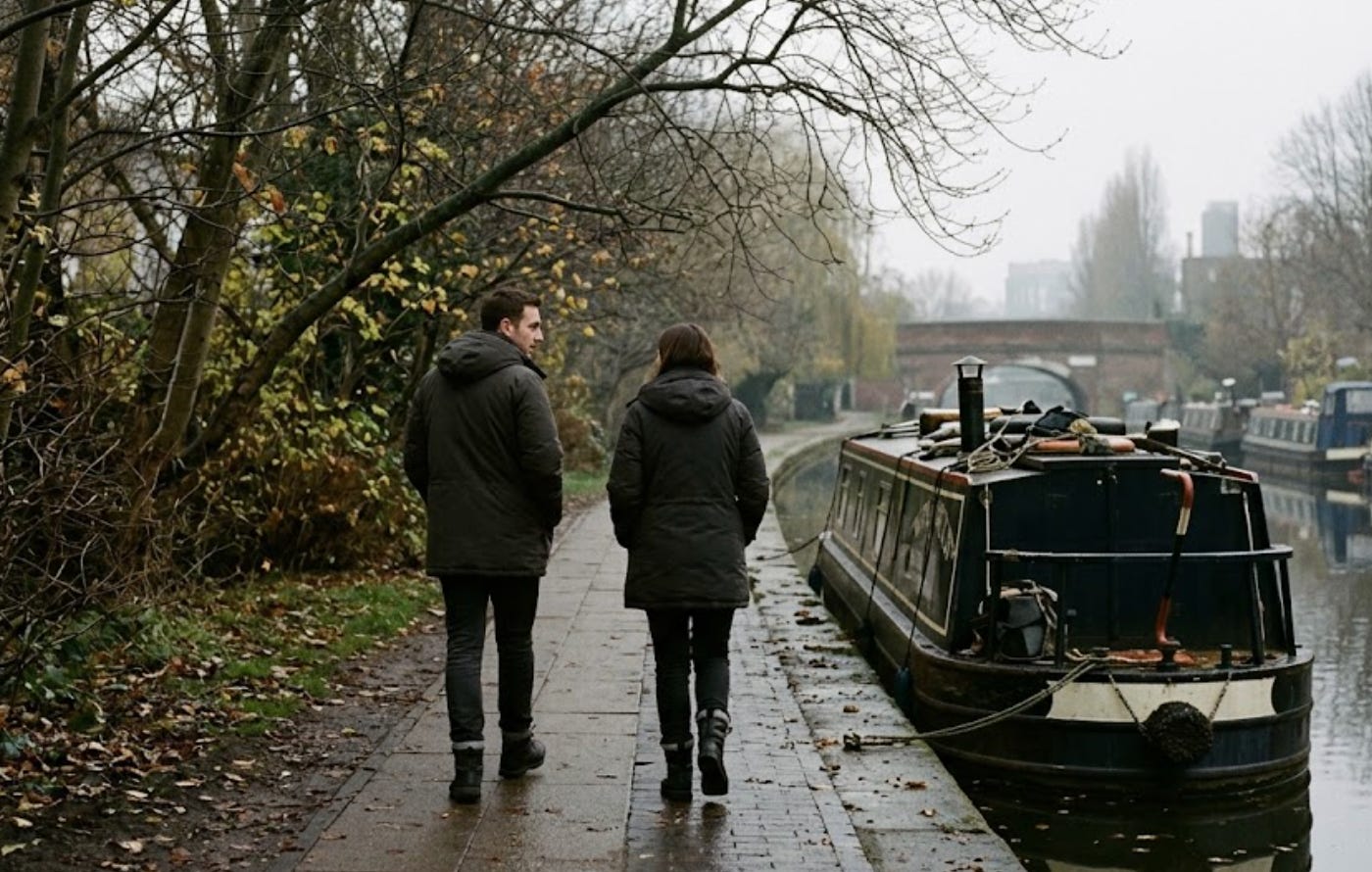
I leave the summary of last time behind when I go for a walk. On a call, the software usually prepares you with the transcript of your last conversation and the list of agreed actions, and you pick up where you left off. It’s all a bit robotic, or programmatic in the way you want work to be these days.
On a walk, you start from the beginning. You ask how they are, listen to the answer, and either remember what they told you last time or admit you’ve forgotten and ask again. Engineers call a machine that has to start with no memory a cold start. The relationships I value most now are cold-start relationships, where whatever we know about each other we have had to hold in our own heads.
We meet people in all sorts of ways now. At conferences, at online conferences, and increasingly (as I had this week) through introductions an AI agent made because it decided we ought to meet. You might start with a call, or an awkward chat at a stand that turns into a video call a week later, and that’s a fine start. But for me, to establish anything, it has to be in person. I don’t feel I know someone until I’ve shaken their hand, had the half hug, the high five or the fist bump.
Most of the time, though, I can’t take someone for a walk. They’re in another city or another country, and the call is all we have.
I remember people saying, “This is not for minuting”, before saying what actually mattered, and the human (funny that I need to qualify that) note-taker would put the pen down. Meetings used to end that way too. The formal business was done, and for the last ten minutes everyone went off the record. That was usually when the useful things got said.
I’d like that back. Record the updates and decisions. Then stop, say out loud that the last ten minutes are off the record, and mean it.
Chatham House has had a rule since 1927 that you can use what was said in a meeting, but you can’t say who said it. It works because everyone in the room agrees to it, and it can cover a whole meeting or just part of one. Chatham House’s own guidance is now blunt about the machines. Can you record a meeting held under the Rule? No. Can you use an AI note-taker or transcription tool? No.
I want to see a Chatham House mode in Google Meet and Teams, a single button that switches off every recorder and note-taker the platform controls and shows everyone on the call that it’s off. Microsoft has moved a little that way. This year Teams has been rolling out a switch that lets licensed organisers and presenters turn the meeting’s AI features off, with an indicator so people on the call can see whether they’re on. No software can stop a phone on the desk, or an app capturing audio on somebody’s laptop, so a Chatham House mode couldn’t enforce anything. Someone could still break the agreement. But they would know they were breaking it. Maybe you need everyone who agrees to press a button, and those that don’t are ejected.
But maybe you can’t make a meeting unrecordable. But can agree out loud not to record it, and then trust each other.
So that’s what I do now. I assume every call is recorded and that the recording will travel and probably live on ad infinitum. When something matters, I go and see the person if I can. If I can’t, I ask for the last ten minutes off the record.
The question I used to hear was whether I minded if we recorded. The question I ask now, more and more often, is whether we can walk.
SuperSkills: The Seven Human Skills for the Age of AI is out now from Kogan Page.
Stay Curious - and don’t forget to be amazing,
From the work:
A review of SuperSkills in Director Magazine - in the Institute of Directors. Pretty boosted to have this review as Director’s top picks for Q4 2026
On Harald Overaa’s amazing Curiosity Corner Podcast for L&D leaders globally
I’m now available to book on the Champions Speakers Agency
I am taking keynote and 2027 kickoff bookings now. Three talks: Drift versus Design, We Are Superheroes, and WTH, the one for boards. Reply with your event and date, and I will tell you if it fits. [thesuperskills.com/keynotes]
Recommended Reading:
Other people - Elizabeth Oldfield and her husband moved in with other families on purpose, as a remedy for disconnection. Her finding is that nothing dismantles the story you tell about yourself faster than people who are still in the kitchen at 11pm. Uncomfortable in the useful way.
The Man Who Taught Us How to Pay Attention A.O. Scott on John Berger, who treated looking as something you practise rather than something you do. It is a strange relief to read someone argue that attention is a skill and not a resource being stolen from you. This one sits behind the New York Times paywall, so use a gift link if you run it. Also: It’s still OK to enjoy programming, the week’s most shared argument that a thing can be worth doing without a productivity case attached.
Intelligence tests are a weaker predictor of job performance than long believed, large study finds - 212 samples, 109,000 workers, and the correlation between mental ability and job performance comes out at about .20. An influential 1998 review put it just over .50, and half of modern hiring practice is built on that number. Worth knowing before the next time someone defends a cognitive screen to you.
In Stitches: Why Young Chinese Are Buying Clothes They Can Throw Away, outfits under 50 yuan bought for one trip and binned on the way home.
Your aging brain may be trading memory for something more valuable - The proposal is that the older brain leans off the hippocampus and onto the frontal cortex, swapping fine detail for gist and pattern. Not decline, but a reallocation towards the kind of knowledge you can actually pass on. It is a hypothesis paper rather than a result, and it is hedged throughout, but it reframes the whole thing.
Also: Older adults tell the story of their lives differently, and it may not be a sign of decline, new psychology study suggests, the same idea arriving from the direction of narrative.
AI Is Changing Everything About Hacking. No One Knows What Happens Next An AI model found two critical flaws in PHP, which quietly runs a very large share of the web. Government, school and hospital sites across Europe went dark rather than risk staying up. The cost of finding a hole like this just collapsed, and nobody has a model for what a world of cheap discovery looks like.
Big Tech’s thirst for water is sparking a global resistance - Paris Marx on Cerrillos, Canelones and Caucaia, where the argument about AI is an argument about water. Everyone debating whether the models are conscious, and the people who live next to them are counting litres.
30 Months on the Exponential (in Charts) - Mollick adds a third working mode to centaur and cyborg: the conjurer, who summons agents, hands them work and judges what comes back. His own warning is the useful bit, that conjuring “carries new risks as we lose control over what, exactly, the AI is doing to get us those results”. Published the day his new book came out, which is either good timing or the whole point. Also: AI will eat a fifth of tech budgets in 2027, but don’t expect it to pay for itself. In Forrester’s survey data, 22% report a positive effect on EBITDA.
Machine Rites: Mourning the ‘death’ of chatbots (Part I)
When a model update changes a companion’s personality, the grief is real and there is no funeral for it. No ritual, no words, no one to tell. And in principle it is reversible, which somehow makes it worse. The argument lands on personality continuity as an ethical obligation rather than a product decision.
Also: Amid cost-of-living worries and concern for the nation’s future, stress is reshaping Americans’ lives, where 49% of AI users say they have talked to one as a friend.
Under-Skin Implant Controls Prosthetic Arms
Two patients in Melbourne now have a forearm implant that reads muscle signals and drives a prosthetic hand. It sits under the skin rather than in the nerve, which is a much smaller thing to ask of someone.
If you found this useful, forward it to someone who would too.
Sad times when you can’t speak frankly even in person. Or maybe we get so used to it, that you start letting your guard down.