
Show Your Working
We were never being marked on the answer.

My book SuperSkills: The Seven Human Skills for the Age of AI is available at all good bookstores, through superskillsbook.com or on Amazon
I work with organisations and leadership teams on SuperSkills, human capability, and AI-era decision-making through speeches, workshops, keynotes and advisory work. In person or virtual. UK, Europe, global. → Book a discovery call | → Explore: thesuperskills.com

Launching SuperSkills in North America
My book is already out everywhere except from North America - and it comes out in 2 weeks in the US and Canada - so I am doing a virtual launch with a free webinar for everyone. It will be held with Salima Valji, CEO of Unleash Forward where we will talk about How to Stay Relevant and Irreplaceable When AI is Changing Everything. It will be held on Thursday, 16th July at 12:00 PM ET / 09:00 PT / 17:00 London / 18:00 Berlin / 20:00 UAE. Sign up for free and find out more here - & share with anyone interested.

Friends,
There was a particular dread that came with the red pen. You would get your exercise book back, find the page, and there it was in the margin. A tick, and then nothing. Or worse, the answer circled, correct, and beside it a number lower than it should have been. You had got it right. You had still lost the marks.
I remember the exact shape of the injustice. The answer was sitting right there. Anyone could see it was right. And the teacher had taken marks away anyway, for a crime I could not understand at thirteen, which was that I had not shown my working.
The red pen had been in my life since I was ten, maybe even younger from my primary school, though no one there ever explained what it wanted. You learned that it existed. You learned to fear it. And you learned that the whole game, as far as any of us could tell, was to get as little red ink as possible. Nobody said why.
Show your working was three of the most resented words in British education. They meant you could not simply arrive at the answer. You had to lay out the middle, the steps, the crossings-out, the line where you nearly went wrong and caught yourself. The answer on its own earned almost nothing. The working earned everything.
The answer was never the thing being marked. The answer was only proof that the working had happened. A right answer with no working could have been copied, guessed, or lifted from the boy sitting next to you. It told the teacher nothing about whether a mind had moved. We thought we were being tested on whether we could produce the answer. We were being tested on whether we could produce ourselves.
There was a second mark in that same margin, and it did something stranger. RTQ. Read the question. You would find it written beside a pupil who had gone off and solved the wrong problem beautifully. But here was the mercy hidden inside it. If you had clearly understood what was being asked, if you had read the question properly and then slipped up somewhere in the middle, you could still be given marks. You could be wrong and still be rewarded, as long as you had understood. And you could be right and given nothing, if you had not.
A British classroom had worked this out decades before anyone needed it to. Understanding the question mattered more than answering it. We had the whole thing backwards as children, and we spent years being gently corrected.
There was a third mark, rarer than the others, and it meant something had gone very wrong. Not a number. Not RTQ. Two words. “See me”.
We had a boy called Dembinski. Polish, broken English, and one of the sharpest minds in the year. For a while he ran the most efficient business in the school. Fifty pence, and he would do your Latin translation for you. There was an irony nobody remarked on at the time, a boy who could barely order his lunch in English producing flawless Latin translation for everyone else, working from an old thesaurus that gave every line the same reach for the grander word. He always had coins in his pocket, and I used to think of him as selling a kind of cheating drug, a Polish Walter White working a corner of northwest London.
His best customer was Faffalios, the one actual Greek in the class, who did enough trade with Dembinski to have negotiated himself a bulk discount. Faffalios had no intention of taking Latin for another year, so his reasoning was airtight. Why learn a thing you are about to put down for good? He had worked out, years before the rest of us, that you could pay to skip the middle. He learned no Latin at all, and he was perfectly content with the arrangement.
Which is exactly how it ended, at least the part you could see. Everyone who had paid handed in the same translation, all of it too elegant for schoolboys, all of it reaching for the same unusual words in the same places. The teachers did not need to be detectives. And what you got, once they had worked out that the answer on your page had been produced by someone who was not you, was those two words in red. See me.
I was never Dembinski’s friend, and I do not know what became of either of him or Faffalios, both probably running private billion dollar businesses somewhere.
Then we grew up and got it backwards again. The machine on your desk does the precise thing the red pen was built to prevent. It hands you the answer with the middle removed. No steps. No crossings-out. No line where it nearly went wrong. Just the clean result, arriving in seconds, looking exactly like the thing you used to lose marks for handing in.
It is Dembinski at a scale no thesaurus could reach.
And it will answer a question you never read. You can type a half-formed, badly aimed prompt, misunderstand your own problem entirely, and receive back a fluent, beautifully structured response to the wrong question. The machine does not write RTQ in the margin. It has no margin. It answers what you asked, not what you needed, with a polish that hides the difference.
For about two years now, a great many of us have been impressed by answers. I have watched people, myself among them, hold up answers a machine produced and feel something close to pride. Look what it made. Look how good it is. We have been marking the answer, awarding it full marks, and forgetting entirely to ask for the working.
I bring up Socrates in keynotes sometimes, and I can feel the room brace. The posture shifts. Eyes drift to phones. Somewhere near the back a person is thinking, here we go, he is going to do philosophy at us. I understand it, because I used to feel it too. So let me get ahead of it. This is not a lecture about a dead Greek. We had a living one in the class, Faffalios, and he was Dembinski’s best customer. What the dead one actually said was closer to a diagnosis, written twenty-four centuries early, of the machine on your desk.
Socrates left nothing in writing. His objection to it, as Plato records, is usually retold as a worry about memory, but the part that matters is why he distrusted the written word. He said a piece of writing cannot be questioned. Ask it something and it gives you the same answer in the same words, and if you press it, it says nothing at all. It cannot defend itself. It cannot show you how it arrived. It sits on the page looking like knowledge while refusing every attempt to test whether it is.
That is a machine that produces answers and cannot show its working.
Ask it to show its working and it will, but the working is only another answer, as fluent and unaccountable as the first.
Socrates wanted the kind of knowledge you could cross-examine. The kind that only exists inside a mind that has done the labour, because only that mind can be asked to account for the middle, to prove the working was real. The red pen wanted exactly the same thing. A teacher writing show your working and a philosopher refusing to write at all were doing the same job, two and a half thousand years apart. Both were saying that an answer you cannot account for is not yet yours.
I used to think the danger of the machine was simply that it made us lazy. That is true, but it is the small version of the problem, and I no longer think it is the one that matters.
The larger version is this. When everyone can produce the answer, the answer becomes the cheapest thing in the room. The same fluent paragraph goes to you, and to the person beside you, and to ten thousand strangers, and proves nothing about any of you. The value has drained back to where it always lived, into the working, and most of us have spent two years attending to the part that no longer counts. We have gone answer-rich and working-poor, fluent in results we cannot account for, able to hand in the answer and unable to show the middle.
Because this is really a question about human capability, and human capability is built in the middle or it is not built at all. Every time you did the working by hand, slowly, badly, with crossings-out, you were building the capability that would one day let you judge an answer, someone else’s or a machine’s. The working was the capability forming in real time. The answer was just the receipt.
I took Latin for years, from a man called Critchley, who once shaved off his beard, walked in, and announced that Mr Critchley could not be in today and that he would be covering the lesson. I could not translate a line of it for you now. I am not sure I ever learned much Latin at all. But I enjoyed it, and I like to think it left me something. Some logic. Some history. The reason I still call on the philosophers now and again, even if they get a yawn. None of that is Latin. All of it is the working. Faffalios thought he was skipping Latin. He was skipping the part that stays.
And for years, we have rewarded the output: the finished paragraph, the polished deck, the answer marked full marks. And we continue to. Nobody rewards the capability underneath, because capability does not show, and a thing that goes unrewarded goes unbuilt. That is the debt we are running up without seeing it. I call it capability debt. The gap between what you can produce and what you could still do if the machine were switched off.
Which is why the hard edge has nothing to do with laziness. You cannot judge an answer you could never have produced yourself. When the machine is wrong, and it is often wrong in fluent, plausible ways, the only person who can catch it is the one who has done that working at least once. Someone who knows where the middle tends to go wrong. Someone who can look at a clean, persuasive result and feel the small wrongness in it, because they have been to that place on foot. Take that person out of the room and you are left with people holding answers, none of whom can tell which ones are true.
We were trained out of the child’s error. We have trained ourselves straight back into it.
I think about the red pen differently now.
It felt like punishment at the time. The marks it took. The working it demanded. Those two words, See me, and the long walk to the front of the class, when everyone ran off to have fun at break time. It was something else. Show your working and read the question and see me were instructions sent decades early, for a test that had not been set yet. Critchley, and all of those teachers, standing at a blackboard in the nineteen-eighties, was preparing me and my generation, without knowing it, for a moment when answers would cost nothing, and the only things left with any worth would be the capability to show how you reached one and the judgement to know whether the question was worth asking in the first place.
We used to dread the red pen.
We should have been dreading its absence.
There was a song we sang at that school, in Latin. Homo plantat, homo irrigat. Not one of us knew what it meant. We had the words exact and the sense nowhere, a room of boys singing an answer none of us could account for, and no one ever troubled to translate it.
It means: one plants, one waters. The increase, the original said, was God’s to give. It is the machine’s to give now. But the planting and the watering, the only parts the song ever asked of a person, were always ours.
They still are.
Homo plantat, homo irrigat.
SuperSkills: The Seven Human Skills for the Age of AI is out now (Kogan Page). It’s written in English. There are some Greek references in there, but no Latin.
Stay Curious - and don’t forget to be amazing,
Rahim Hirji Author, SuperSkills (Kogan Page, July 2026) | Keynote Speaker | Advisor
→ superskillsbook.com → thesuperskills.com → Book a discovery call
PS. If your organisation is thinking about AI and human capability, I keynote and advise on this.
Tools I Use:
Jamie: AI Note taker without a bot. You join the meeting. The Bot doesn’t.
Wispr Flow: Just dictate everything to your laptop and phone. Game Changer
Prompt Cowboy: Prompt Generator. Extract intelligence.
Manus: Best AI agent to do things for you. Agentise your intelligence.
Chat Hub: Multi-model intelligence
Claude Cowork: Delegate complex tasks to your friendly Claude Agent
SuperSkills in the Wild:
Send me images of your copy of SuperSkills and I will include them here. Bonus point for creative locations, tourist spots, spotting of the book in the wild, in a book shop etc.
My piece touching on SuperSkills in Entrepreneur magazine: Why AI doesn’t create bad decisions, it just exposes them faster
On the BBC last week. You can find me interviewed for SuperSkills at 37 minutes onwards
Talking Edtech and SuperSkills on MSN: How Sweden’s ‘edtech’ catastrophe became a cautionary tale for Britain’s digital-first classrooms
My article for CEO World Magazine talking about the main concept of SuperSkills: Drift versus design: why most companies mistake activity for transformation
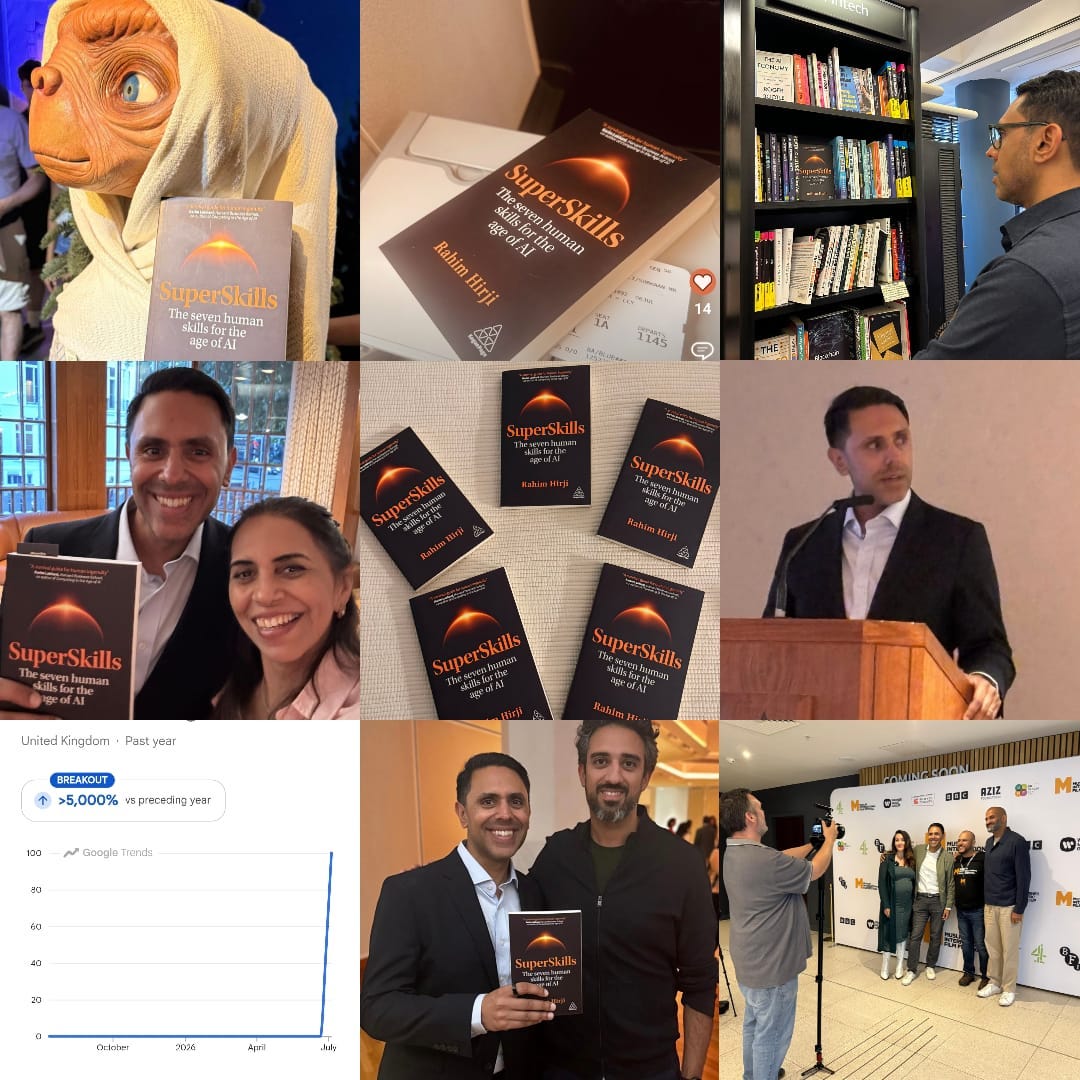
Send me your images of SuperSkills in the wild, in bookshops, on holiday. Best photo gets a prize.
Recommended Reading:
The People Who Will Thrive in the AI Age - What will differentiate people is not how smart they are but their relationship to mental effort.
Beyond access: Why real AI literacy will define the future - WEF MUST READ
What Happens When Parents Say “I Was Wrong” - A research-backed exploration of how parental apologies and taking accountability strengthen family relationships and teen well-being.
The 16 Best Summer Books of 2026 Esquire’s curated list of the season’s best books to stuff in your suitcase, from gripping bestsellers to unsung literary gems. Obviously haven’t received SuperSkills yet.
How to Remember a Person’s Name (And What to Do When You Can’t) - Practical techniques for remembering names during introductions and graceful recovery strategies when you inevitably forget.
We Are Losing the Ability to Discover What We Didn’t Know to Ask
An opinion piece on how AI-driven search eliminates the meandering, serendipitous journeys that drive scientific and artistic breakthroughs.
The End of Reading Is Here The Atlantic’s cover story examining the alarming decline in reading across all age groups and what a post-literate society means for civilization.
The ‘Merge’ With AI Has Already Begun - A look at how artificial intelligence is quietly insinuating itself into every corner of our lives and what it means for humanity’s future.
Feeling Stuck? Try ‘Productivity Snacking’ - How splitting your goals into bite-size chunks—whether it’s learning guitar or getting fit—can work wonders for your motivation and progress.
Why Climate Politics Can’t Wait - An argument against the recent trend of “climate hushing,” explaining why politicians must keep talking forthrightly about the realities of climate change.
If you enjoyed this, forward it to someone who’d find it useful. And if you haven’t yet, order SuperSkills at superskillsbook.com