
Solving Synthetic Seniority
The Last Thirty Per Cent

My book SuperSkills: The Seven Human Skills for the Age of AI is available at all good bookstores, through superskillsbook.com or on Amazon
I work with organisations and leadership teams on SuperSkills, human capability, and AI-era decision-making through speeches, workshops, keynotes and advisory work. In person or virtual. UK, Europe, global. → Book a discovery call | → Explore: thesuperskills.com
Friends,
In case you missed it - and how could you? - My book launched this week. I wrote about how I planned it - and how the launch party didn’t go to plan in my piece The woman in the back of the room. I know you will love it.
On to this week:
Justine runs a studio that makes the fifteen-second films you try to skip before the button lets you. The work is a car on a coast road, a bank that promises to understand you, a soft drink and some snow. It goes out under the names of FTSE 100 companies, where the bar is unforgiving, because a frame that is almost right reads as wrong to an audience that could never tell you why.
She gave her graduates a brief one morning and took their laptops away, no software, only pen and paper and whatever they could reach with their own hands and their own eye. She set the same brief for Niamh, one of her designers a few years further on, and let her work the way she always worked, which was to open the tool and begin.
Niamh finished first, the way she always finishes first. When the display ads were laid across the table side by side, every one the graduates had built by hand was better than hers. She was faster than every one of them, and she was not good enough. In the work Justine sells, good enough is average, and average does not sell.
There is a name for what Niamh has. I call it synthetic seniority, and I have been saying it out loud to everyone who will listen for a while now. It is work that looks senior, sounds senior, and passes every inspection in the room except the one that matters, while the judgement underneath it was never built.
When I first wrote it down, I described a junior, a second-year with a strategy deck, a trainee with a memo that reads three grades above her experience. I had it too narrow. AI rarely takes a whole job; it takes tasks out of the middle of one, and what is left gets bundled with other people’s work until nobody is doing the job they were hired for, in a period when the shape of every role is still moving under everyone’s feet.
That is why synthetic seniority is broader than plain inexperience. A person can be a real master of the thing they were trained in and still be synthetically senior, because the world has handed them two other crafts they have never practised and called the bundle their job. The gap is not inside them, it sits between them and a role that did not exist two years ago. It is the engineering manager who now owns the product roadmap too, learning it in public. It is the solo operator doing her own finance and marketing because the walls between those jobs fell in. It is the director of twenty years whose craft is intact and whose world has rearranged itself around her. Almost everyone is somewhere in that shift now. It is why the room turns when I say the words, and why people have lived inside the thing for two years without a name for it.
Go back to Niamh, though, because her morning explains it better than any definition. The easy conclusion from Justine’s experiment is that the tool made her worse. It did not. What it gave her was a floor - the floor. Whatever she makes arrives at a certain level and never drops below it, because the software was trained on a gazillion competent things and competent is what it gives back. It cannot fail her, and it cannot lift her. The pattern I keep seeing across these creative firms is that the work settles at an average and stays there, and the number I have come to put on that average is seventy per cent.
She mistook the floor for a ceiling. Everything she made was fine, and because it was fine, she stopped doing the thing the graduates were forced back into that morning, which was to be bad, by hand, over and over, until their hands learned something. Nobody had told her those repetitions were the point. They are the ones that build the last thirty per cent, and the tool will hand anyone the seventy. The last thirty has only ever been built the slow way, by making the work badly enough times that your eye changes.
In Justine’s trade, seventy per cent does not merely underwhelm, it gets skipped, and the reason is measured in seconds. Most ads get under two seconds of a distracted person’s attention before the scroll, roughly the threshold for forming any memory of them at all. Competent does not win that sliver. It is precisely the level that gets ignored, because it is good enough to be inoffensive and nothing more. The whole value of the work lives in the part that seizes a bored stranger before the thumb moves, and that part is the one the tool cannot reach.
The seventy passes everyone but one person in the building. It passes the client, who is delighted and on time. It passes the account lead. It passes the junior review, because the juniors sit at seventy themselves and cannot see above their own line. The only person who sees what is missing is Justine, because she climbed it herself, years ago, and someone who has climbed something by hand can always tell when someone else took the lift.
Justine has watched this coming. She talks about the Coca-Cola Christmas ad from last year, the one that rebuilt the old red trucks and the snowy towns with generative AI, a year of work done in a month, cheaper, faster, and received as something soulless. Her objection is not that it looked cheap, because it did not. It is that it looked like nothing, a competent nothing produced at a scale nobody could previously afford. She talks about the ads that still work, the John Lewis Christmas films people wait for each year, and how much human doubt goes into every cut before it airs. She has watched people get burned handing the tool the part that was theirs to hold.
None of this, though, is where Justine started. She is fifty-five-ish and vapes, the oldest person I know who does, and for most of twenty years she ran the studio like a lifestyle business that happened to be large, loose and generous and built around the work being a pleasure. She was a tools-first believer then, the one in the room telling everyone the software was the whole future, moving faster than the people around her and proud of it. She would have argued Niamh’s side without blinking, because for a long time it was her own. She did not take the laptops away to catch her graduates out. She took them away because she had begun to suspect something about herself, and she wanted the answer even though she feared it. The result caught her. Her most promising designer lost to a line of graduates working with their hands, and underneath that loss was the road she had spent two decades on. She took the answer and did the hard thing with it, and began pulling her whole practice apart to rebuild it.
It cost her. It also turned her into a different kind of boss, the lifestyle business gone, the place run like a turnaround now. Slower and dearer than a studio running everything through the tool, she lost clients who only ever wanted it fast and cheap, and some of them never came back. Revenue is down and has stayed down. The studio makes more profit on less work now, though she is honest that some of that is not vindication, it is a smaller team, people who were there before the turn and are not there after it. That is the kind of result nobody puts on a conference slide, because it is not a triumph and it is not a warning, it is just what the honest version cost, and who it cost. it’s messy
What she is rebuilding towards is visible in the work itself. Two of the most effective films ever made in Britain show what the last thirty per cent actually is.
John Lewis spends every Christmas making the country cry over a boy and his monster, or an old man alone on the moon, and none of it is sentimental by accident. The firms behind those ads measure the feeling precisely, tracking what a viewer feels from second to second, because emotion is what a person remembers and what moves them months later at the till. A story without friction gives no release, and the wrong music kills the moment it was built to carry. The crying is engineered, built on purpose by people who have spent careers learning how feeling is made, and it is the part no tool can originate, because it has to come from someone who has felt the thing themselves.
Then there is the strangest of them. In 2007, after a contamination scare had damaged the brand, Cadbury aired a film in which a gorilla sits at a drum kit for the better part of a minute, waiting, while a Phil Collins track builds, and then plays the famous fill, with no chocolate on screen until the final seconds. It made no rational sense and should not have worked. It rescued the brand, sold chocolate, sent the song back up the charts and won the Film Grand Prix at Cannes. And it began as an office argument about who had recorded the best drum solo of all time. The people who made it could never quite explain how they got from the argument to the gorilla. The marketing director said he heard the idea, did not fully understand why, and knew in that instant they had to make it. A machine can throw out a strange association by the thousand. What it cannot do is know, in its bones, why this particular strange thing is worth betting a battered brand on. That knowing comes from a person, and only from a person.
What the engineered tears and the inexplicable gorilla have in common is a refusal to stop at the point where everyone else in the room was already satisfied, a reach past good enough into something slightly irrational in the way people are and machines have no reason to be. That reach is the whole of the last thirty per cent.
The leap was human, and everything after it was craft and testing and doubt. Cadbury held the launch back to research the idea properly. A specialist studio built the suit. A performer trained for weeks to drum convincingly inside it. The film was placed with care, at the right moment, in front of the right audience. A human at the start, where the idea that crosses the threshold is born. Testing and rigour in the middle, where a good idea is pressure-tested and delivered. A human again at the end, where taste decides when it is finally right. The gorilla was made in the shape Justine is now rebuilding her studio to work in.
Somewhere in here is a fairer question than the one everyone asks. It is not whether you use the tool, because everyone uses the tool. It is where. Some work is transactional, the expense report, the meeting notes, the first pass of an email you were going to rewrite anyway. Hand every scrap of it over, talk a good game, and lose nothing, because none of it was ever going to be the thing your name is really on. Some work is representative. It is the work that is you, the frame that has to seize a stranger in under two seconds. Use synthetic seniority in the transactional zone and it is a debt you can carry for the rest of your life and never be asked to repay. Let it cross into the representative zone and it becomes a loan that gets called, always at the worst moment, always in front of the client, always on the day the tool has no answer and the room turns to you.
The border between the two has gone faint. When everything arrives at the same competent level, on the same screen, in the same clean font, the transactional and the representative start to feel identical, and you stop being able to feel which is which. When the competent thing looks the same whether it took thirty minutes or thirty days to make, the eye goes blind, and the seventy starts to look like a hundred, because there is nothing left to hold it against. A person who cannot feel the border will let the debt cross it without noticing, because nothing at the crossing looks any different from anything else.
The danger I wrote about the first time was a broken pipeline, a generation promoted past its judgement, a leadership vacuum waiting for the next crisis to open it. That is real. It is also not the worst of it, and Justine’s eye is what shows the worse thing. Everything rests on there being a Justine in the room, someone who climbed the hard part by hand and can therefore see, at a glance, when it is missing. Take that eye out of the building, by retirement or redundancy or the simple passage of time, and the seventy stops being caught, because nobody left can see that it is only seventy. Work that is never flagged as below standard does not stay below standard. It becomes the standard. The ceiling drops, and it drops without anyone noticing, because the only people who could have told you it used to be higher have already gone. A whole trade can forget what its own best looked like inside a single generation, and then forget that it has forgotten.
Justine turned, and that is the rarest part of the story. She was on the wrong road and she corrected, and most will not, because correcting means running an experiment whose answer you already dread. The tools-first veterans who never run it will go on approving the seventy from above while the juniors produce it from below, and between them, in good faith, they will agree that seventy is what a hundred always looked like.
So the correction is not a policy. Justine is not writing a framework, and the last thing any of this needs is another three-step programme with prompt logs and an oral exam, which is roughly what I proposed the first time I wrote about synthetic seniority, and which mostly gives organisations a way to feel busy. What she is building is the shape the gorilla was already made in. A person starts the work, holding the judgement about what the thing is even for, the taste, the read of the room, the sense of what would make a stranger stop at all. Then the tools do what they are honestly faster at, the drafting and the variants and the testing a human would take a month to grind through. Then a person finishes it, and the finishing is where the hard part goes back in by hand. Human, then machine, then human. It sounds obvious written down, and almost nobody does it, because the tool in the middle is so fast and so plausible that the pull is to let it run all the way to the end and ship the seventy.
Niamh is arriving at the same place from the other side. She has not put the tools down, she is learning where in the work to pick them up, which is later than she used to, and for less than she used to, and never for the part that is representative. The veteran is learning to let the machine in. The junior is learning to keep it out until the right moment. They are walking towards each other, and the place they meet is the only version of this that holds.
Justine took the laptops away to find out what was still there without them. It is the most useful question I have heard all year, and it is not really a question about designers. Take the tools away from your own week, not the expenses and the notes, but the work with your name on it, the work that has to cross the threshold. What is still there? What can your own hand or brain still do?
Before you answer too quickly, remember who Justine is. She is not a sceptic who never trusted the software, she is a believer, a tools-first woman of twenty years, heading exactly where Niamh was heading, who almost did not turn in time. If it took her a stripped-back room and a line of graduates beating her best designer to see what was missing in her own studio, then your certainty that you would catch it in your own work, unprompted, with nobody taking your laptop away, might be the most synthetic thing you own.
SuperSkills: The Seven Human Skills for the Age of AI is out now. The whole book is really one long argument for climbing the last thirty per cent yourself.
Stay Curious - and don’t forget to be amazing,
Rahim Hirji Author, SuperSkills (Kogan Page, July 2026) | Keynote Speaker | Advisor
→ superskillsbook.com → thesuperskills.com → Book a discovery call
PS. If your organisation is thinking about AI and human capability, I keynote and advise on this.
Tools I Use:
Jamie: AI Note taker without a bot. You join the meeting. The Bot doesn’t.
Wispr Flow: Just dictate everything to your laptop and phone. Game Changer
Prompt Cowboy: Prompt Generator. Extract intelligence.
Manus: Best AI agent to do things for you. Agentise your intelligence.
Chat Hub: Multi-model intelligence
Claude Cowork: Delegate complex tasks to your friendly Claude Agent
SuperSkills in the Wild:
Send me images of your copy of SuperSkills and I will include them here. Bonus point for creative locations, tourist spots, spotting of the book in the wild, in a book shop etc.
A recommendation for SuperSkills: AI and volunteer engagement: threat, distraction, or opportunity?
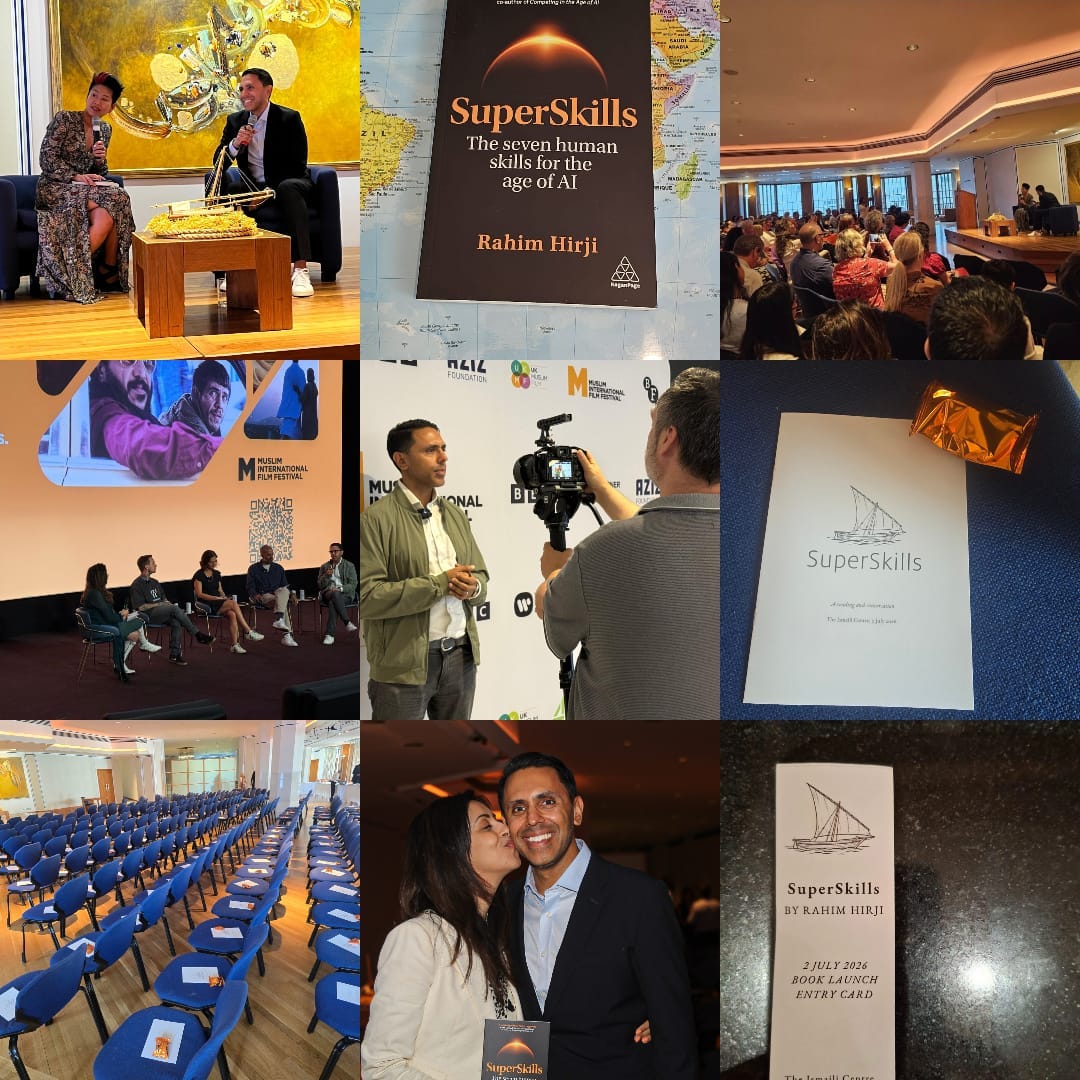
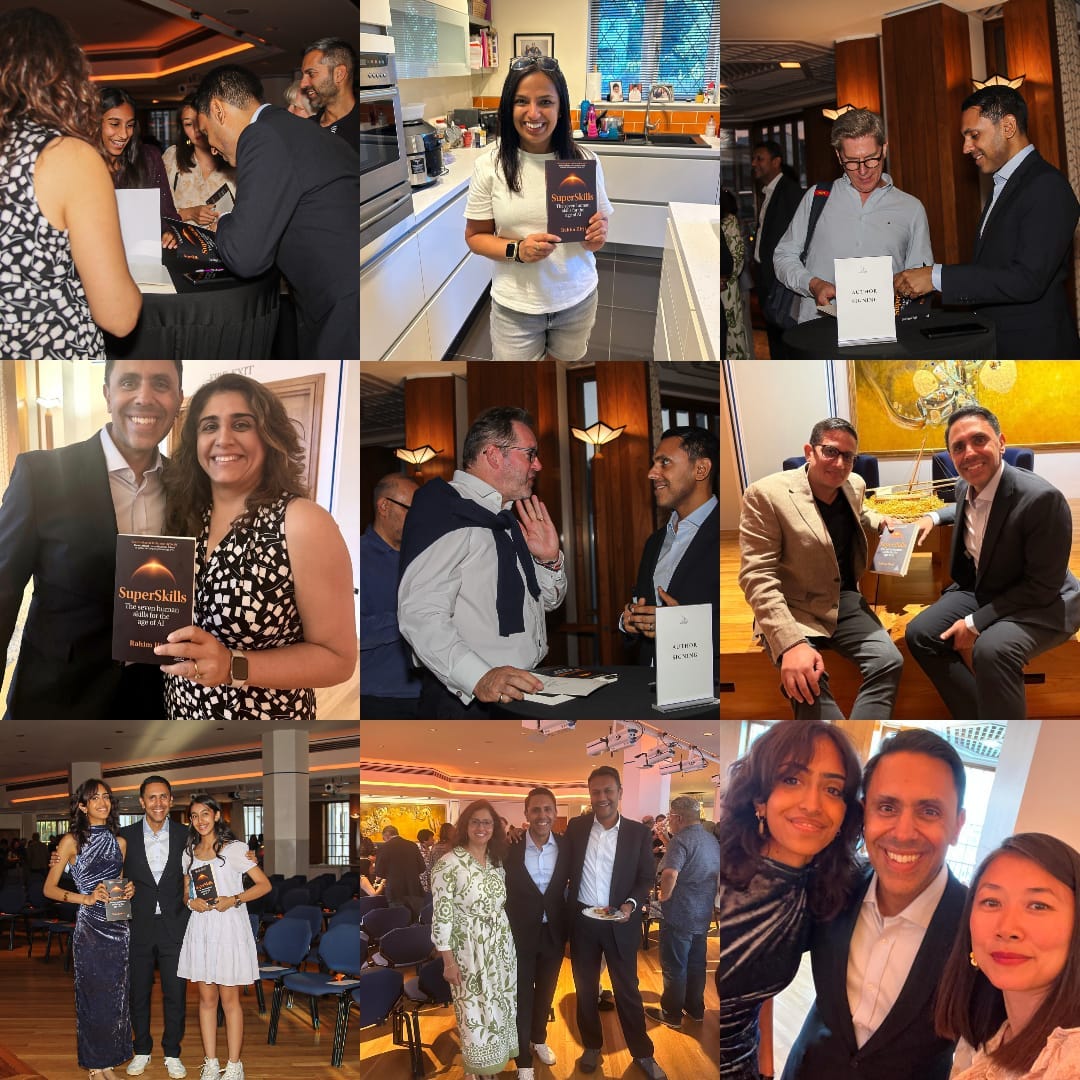
The Woman at the Back of the Room

My book SuperSkills: The Seven Human Skills for the Age of AI is out now. Buy through at superskillsbook.com or on Amazon
Recommended Reading:
Your AI Is Not a Tool. It is an environment, and you are in it.
Warm Collar Labor - The economy is getting touchy-feely.
Greatness and the Machine - A warning that AI’s real danger isn’t a robot uprising but a “soft despotism” where we voluntarily outsource our will to a tool that thinks before we do.
The Anti-Amazon - Costco’s deliberately constrained, high-friction model is thriving against Amazon’s infinite-aisle future—a deep essay on why less choice might be the better economy.
What Is the United States of America Now? - Rebecca Solnit’s sweeping, poetic essay for the 250th birthday: “A truck that has driven into a ditch… a program that has been hacked.” Also: “the country that gave the world jazz.”
A.I. Is Reshaping the Economy. Good Luck Measuring How.
Nobody can agree whether AI is destroying jobs, creating them, boosting productivity, or doing nothing at all—a fascinating look at the measurement crisis.
Wish You Were Her — A hilarious, surreal dispatch from a cruise ship populated entirely by celebrity impersonators, where “every child starts to look like Wallace Shawn.” - very funny
Why You - the absurdity of selfhood: you are a story assembled from cosmic chance—atoms bonding one way, parents meeting one night—and attachment to that story is the deepest illusion.
The Bottleneck Might Be the Air in the Room - elevated indoor CO₂ levels are silently degrading your cognitive performance, and most offices are well above the threshold.
Protect Your Right to Run Local AI — Right to Intelligence - A manifesto arguing that the ability to run AI models on your own hardware is a fundamental right—before regulators and cloud providers lock it down.
If you enjoyed this, forward it to someone who’d find it useful. And if you haven’t yet, order SuperSkills at superskillsbook.com