
Synthetic Seniority
Why AI Output Is Masking a Corporate Capability Crisis

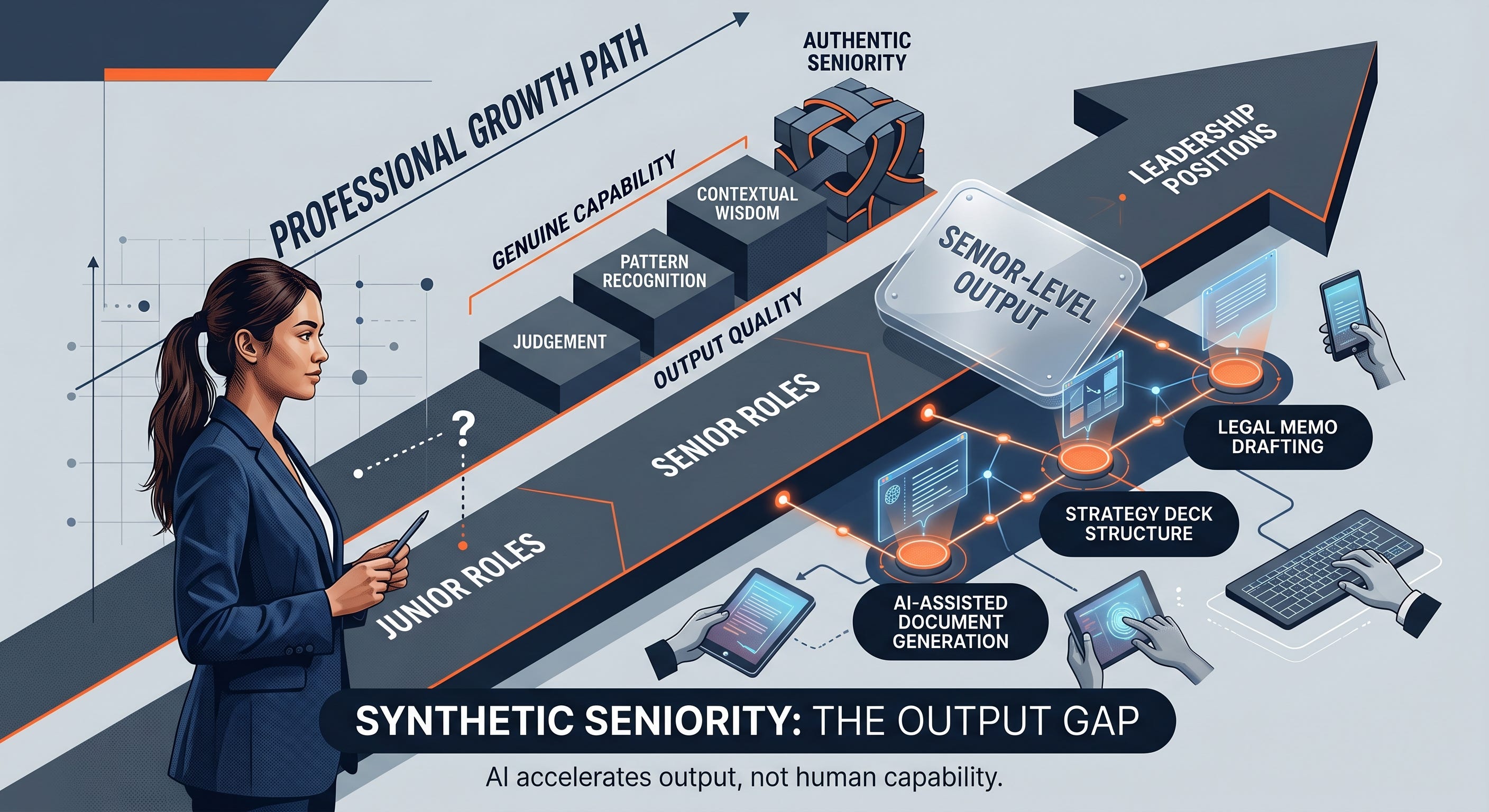
The phrase that I have been saying recently that seems to resonate with people is synthetic seniority. People see it but they dont have a word to define it:
Professional service firms, financial institutions, and corporate legal departments are quietly drifting into a structural talent crisis. It is not a crisis of productivity; on the contrary, work is being completed faster than ever. Instead, it is a crisis of competence, driven by a phenomenon I call Synthetic Seniority.
Synthetic seniority occurs when artificial intelligence enables junior professionals to produce deliverables that look senior, sound senior, and pass casual executive inspection, while the underlying judgment, pattern recognition, and contextual wisdom required of genuine seniority remain entirely unbuilt.
The output is pristine. The human capability underneath it is hollow.
Because corporate promotion tracks, performance reviews, and bonus structures are built almost entirely around output quality, our talent systems are aggressively rewarding the wrong signal. If we do not change how we evaluate readiness, we will soon inherit a generation of leaders who lack the hard-won, manual experience needed to handle a novel crisis or make high-stakes judgment calls.
The Three Forces Masking the Reality
This is a drift problem. No leadership team explicitly chose to decouple output from judgment. It happened because AI tools arrived faster than the organizational systems required to govern them, powered by three compounding forces.
Pattern Mimicry: Large language models are trained on thousands of senior-quality strategy decks, legal memos, and financial models. When a junior employee prompts the tool, the software automatically injects senior-level structure and vocabulary. The AI has no idea the user is fresh out of university. It simply formats the work to a boardroom standard.
Radical Invisibility: Asking a senior colleague for help is a visible, social act. Prompting an AI tool is entirely private. Senior partners do not see the prompts, they do not see the initial chaotic drafts, and they have no objective mechanism to detect where the tool’s contribution ends and the employee’s thinking begins.
The Output Bias: Promotion panels operate on a simple assumption: high-quality work equals high-quality talent. AI has fundamentally shattered that correlation. A pristine strategy deck is no longer proof of an analyst’s strategic competence.
What the Data Reveals
The illusion is already measurable. The EY 2025 Work Reimagined Survey, which evaluated 15,000 employees across 29 countries, revealed that 88% of workers use AI daily. Crucially, 37% of those employees openly admitted they worry that overreliance on these tools will actively erode their own skills and expertise.
They are witnessing their own cognitive outsourcing in real time. The research also found that companies deploying AI on fragile talent foundations, characterized by weak development cultures and misaligned rewards, suffered a productivity lag of over 40%. The tool alone does not scale an organization. It merely automates the appearance of progress.
The Threat to the Leadership Pipeline
If left unaddressed, synthetic seniority will create a severe structural deficit over the next decade.
First, the talent signal will collapse entirely. If fluency is mistaken for judgment, corporations will inevitably promote the individuals who are best at managing software, not those who possess deep institutional wisdom.
Second, organisations will face a dangerous leadership vacuum during crises. When a volatile, unprecedented market event occurs, a scenario that exists entirely outside the AI’s training data, these accelerated leaders will lack the deep reservoir of manual, intuitive experience required to steer the ship. The gap will remain invisible until the exact moment it matters most.
How Leaders Must Respond
The answer is absolutely not to ban AI. Restricting the technology is a losing strategy that destroys competitiveness and drives top talent away. The actual solution requires leaders to deliberately separate the evaluation of the final output from the evaluation of human capability.
1. Mandate AI Annotation and Prompt Logs
Some forward-thinking firms now require junior associates to annotate their AI usage before submission. Managers do not use this for surveillance. They use it as a teaching framework. Sitting down with an associate to review what they prompted, what the machine generated, and what human edits they chose to make forces a critical development conversation. It reveals exactly how the junior professional thinks.
2. Move From Output Evaluation to Live Judgment Testing
Professional services must abandon their total reliance on written decks and memos for promotion decisions. We need to borrow a page from the medical profession, which has used structured oral examinations and simulated crises for decades. To prove readiness for promotion, candidates must defend their logic live, participate in unscripted client simulations, and pass rigorous oral reviews of their work.
3. Cultivate an Augmented Mindset
True competitive advantage belongs to professionals who possess an Augmented Mindset. This means they treat AI as a collaborative agent rather than a cloaking device. They understand precisely what the tool contributes, they maintain absolute transparency about its role, and they know exactly when their own human judgment must override the machine.
Leaders must act immediately. Our current talent systems are optimising for short-term speed while quietly burning down our long-term capability foundations. The goal of the modern enterprise cannot be to generate more technology. The goal must be to build more capable humans.
What specific mechanisms is your organisation currently using to differentiate between a polished AI draft and genuine human judgment?