
The Crossing
Hope is not a feeling. It is a skill.

Now accepting speeches, keynotes and assignments for 2026
I work with organisations and leadership teams on SuperSkills, human capability, and AI-era decision-making through speeches, workshops, keynotes and advisory work. In person or virtual. UK, Europe, global. → Book a discovery call | → Explore: thesuperskills.com
In addition to this newsletter, I recommend a few others. All free. Check them out here.
Friends,
“Are babu, are babu, ek paisa de? Ek paisa de?”
Give me a coin. Just one coin.
I read A Fine Balance by Rohinton Mistry in my twenties. I gave my wife a first edition for our first wedding anniversary, since folklore deems it necessary to buy something paper-based to celebrate 365 days into a life commitment. That said, it is, without question, my favourite novel. Set in 1970s India during the Emergency, it follows four characters whose lives collide in a cramped apartment in an unnamed city. Two of them, Ishvar and Omprakash, are tailors from a lower caste who have already survived things that would break most people. By the end of the book, they are begging on the streets. Not because they lacked talent or work ethic. Because the system they were born into had a ceiling, and every time they reached for something better, someone pushed them back down.
A person asking for a single coin. Not out of laziness or failure, but because the world they inhabited offered no ladder tall enough to climb out of.
And yet they kept asking. That’s the thing about the book that breaks you. They kept asking. They kept showing up. They kept believing, against all evidence, that tomorrow might be different from today.
There is a word for that. The word is hope.
The devastation of Mistry’s novel is not that bad things happen to good people. It is that hope is given and then taken away. He builds it carefully, patiently, across hundreds of pages. The characters find work. They find friendship. They find something that looks like dignity. And then the system, indifferent and absolute, crushes it. One character loses his hope so completely that he walks in front of a train. The others survive, but only by learning to exist in what Mistry calls a fine balance between hope and despair. That is crueller than never having hope at all.
I think that’s why I love the book. Not despite the devastation but because of what it illuminates. My family’s story (that I know of) started in the same geography, the same conditions, the same era. The difference between my ancestors and Mistry’s characters is not talent or character. It is that the system let my family keep their hope. They got to act on it. They got to leave. They got to climb.
My hope has not died. And perhaps that is the only thing that separates a life that expands from a life that contracts.
In the early part of the last century, one of my forefathers boarded a boat from Gujarat to reach East Africa, where the British were investing in a rail programme. The details have softened with time, the way family stories do, but the core fact remains: he chose to leave. He chose the uncertainty of East Africa over the certainty of poverty in a place where caste, resources, and geography had already decided what his life would look like.
That choice was not courage, though we like to call it that when we tell the story. It was hope. The belief, unverifiable and irrational, that the unknown would be better than the known. Hope is the only force strong enough to put a person on a boat with no return ticket.
He didn’t have a career plan. He had the ability to endure. The capacity to make decisions when every option is bad. To keep moving when the rational response is to stop. To solve the problem of today without knowing whether tomorrow will be worse.
My family survived. And from that survival, the next generation built something different.
There is a shape to how human capability evolves. I’ve spent years studying it and I first noticed it in my own family. It looks like a ladder. Five rungs. Survival skills at the base: the raw ability to endure. Street skills above that: the ability to navigate. Specialist skills next: portable expertise you can certify and sell. Soft skills above that: the human capabilities that let you lead, connect, and influence. And at the top, the rung that matters most right now: SuperSkills. The capabilities that remain stubbornly, irreducibly human in an age when machines are learning to do everything else.
I call this the SuperSkills Ladder. Each rung builds on the one below. You don’t abandon survival instincts when you develop street skills. You don’t lose empathy when you gain expertise. The ladder layers rather than erases. And every generation, every crossing, every act of hope adds a rung.
My grandfather grew up in East Africa with the survival instincts his parents had given him, but he added a layer they couldn’t have taught. He learned to read people. To negotiate without leverage. To adapt to rooms where he was the outsider and find a way to belong anyway. He earned the nickname “Cheka Cheka,” Swahili for “Laugh Laugh,” because he understood something profound: charm is not a personality trait. It’s a tool. In the right hands, laughter disarms, connects, and opens doors that credentials never could.
I call these street skills. You can’t get a degree in reading a room. There’s no certification for knowing when to push and when to wait. These skills are forged in the gap between what you need and what’s available.
Every immigrant community in the world has a version of this story. The Gujarati traders who built networks across East Africa. The Punjabi families who turned corner shops into empires across Britain. The Vietnamese refugees who arrived with nothing and rebuilt through sheer resourcefulness. The Polish workers who navigated a new language and culture to establish themselves across Europe. The street skills were different in each case, but the pattern was identical: you take survival and you turn it into strategy.
And then, eventually, the strategy becomes something more formal.
My parents’ generation climbed again. In London, they became specialists. My mother chose midwifery and spent her career at Harefield Hospital. My father trained as an accountant but became what the Asian community calls a businessman. These weren’t survival trades. They were deliberate investments in portable expertise. Credentials. Qualifications. The kind of knowledge that would provide predictable security regardless of what the world did next.
We built an entire economy on the assumption that specialist skills last. We treated them the way you treat a house: something solid, something permanent, something that would always hold its value.
But specialist skills are not a house. They are ice. They are already melting. I was coding in C at university, many years ago. I never used it in a real job. It was obsolete almost as soon as I learned it. That’s not a failure of my education. It’s the nature of specialist knowledge. It was always temporary. We just pretended it was permanent because the world changed slowly enough to maintain the illusion.
The world no longer changes slowly.
A friend of mine, a finance director in his fifties, recently didn’t get a job because he lacked a formal AI certification. Mostly theoretical. By the time he had the certificate, half of what it covered was already outdated. He framed it anyway. It hangs on his wall like a photograph of a place that no longer exists.
The people who advanced in my career weren’t the most technically gifted. They were the ones who could walk into a room full of tension and find a way through. The ones who could say difficult things without making enemies. The ones who made other people feel heard, and in doing so, earned the kind of trust that no qualification can buy. These were soft skills. And for decades, they suffered from the worst branding in the history of professional development.
“Soft” sounds optional. Like the thing you do after the real work is done. But anyone who has ever lost a job because they couldn’t navigate the politics, or watched a brilliant colleague fail because they couldn’t communicate, or seen a team fall apart because nobody knew how to listen, knows the truth. These skills are the hardest to build and the hardest to replace. They take years, not courses. They require failure, not frameworks.
And unlike specialist knowledge, they don’t melt. The ability to listen, to persuade, to sit with someone in difficulty and say the right thing at the right moment: these get stronger with practice. They compound over time. They are the opposite of ice. They are bedrock.
The question is what happens when even bedrock starts to shake.
Picture a street in an Indian city. Not the India of tech parks and startup hubs. The older India. Dust on the road. The smell of chai from a stall with no signage. A man sits on a piece of cardboard at the edge of the pavement. He has been here since before dawn. He will be here after dark.
Watch him for an hour and you will see something both strange and amazing.
He reads every face that passes. Not casually, the way you might glance at someone on a train. He reads them the way a surgeon reads a scan: quickly, precisely, with consequences attached to the diagnosis. That woman will give. That man will not. The couple will give if you approach the woman first. The businessman will give if you don’t make him stop walking. This is curiosity refined to an edge. The same curiosity that drives a researcher to notice what others overlook, a founder to see a gap in a market, a child to ask the question that silences the room.
Watch longer and you will see empathy. Not the performative kind that gets praised in leadership seminars. The real kind. When another beggar, older, weaker, settles nearby, there is a negotiation that happens without words. Territory is shared. Sometimes food is shared. There is an understanding of what the other person needs that requires no language, no training, no certification.
You will see adaptability. When the police come, the cardboard disappears in seconds. The man is standing, walking, blending into the crowd as though he was never there. When the monsoon arrives, the entire strategy shifts. Adaptation is not something he learned on a course. It is how he has stayed alive.
You will see systems thinking. He knows the rhythms of the city the way a trader knows the rhythms of a market. Which streets are generous in the morning and hostile at night. Which festivals bring charity and which bring indifference. He maps the system not because someone taught him, but because the system is what stands between him and eating today.
These are not lesser versions of the skills that executives develop in expensive leadership programmes. They are the same skills. The difference is context, not capability. None of this dignifies deprivation. It only reminds us that human capability is most visible where comfort is absent.
The human skills were never invented. They have been with us since we first looked at a stranger and tried to figure out whether they were a threat or an ally. What the age of AI has done is reveal them. When machines take the specialist work and begin to mimic the soft, what remains visible, what becomes undeniable, is the substrate that was underneath all along.
The beggar on the dusty street has these skills. The question is whether the executive, sitting in a climate-controlled office with a dusty brain, still does.
I used to travel to India regularly for work. On one of those trips, I asked a colleague how difficult it would be to trace my family’s roots. To go back to wherever in Gujarat the records might be. To find the town, the register, the list of names.
He looked at me the way you look at someone who has asked a question that only makes sense from the outside.
His family had lived in the same house for generations. The heads of the house had changed. Three generations of two families now shared the rooms. The walls were the same walls his grandfather had known. The courtyard was the same courtyard his children played in. The rooms remained the same. The people had changed, got older, grown. But the house held.
He couldn’t quite understand why I would need to go looking for something that, in his world, had never been lost. The temple, the records, the community, the history: it was all within walking distance. He hadn’t needed to cross an ocean to find belonging. He had it. He had always had it.
What struck me was not the difference between us but the similarity. He had grown and evolved just as much as my family had. He had adapted to new technologies, navigated complex relationships, built a career, raised children, developed judgment. He had curiosity, empathy, adaptability, the ability to see how things connected. He had all the skills on the ladder. He had just built them in one place, in one house, across one lifetime planted in the same soil his grandfather had planted in.
We tell stories of progress as though they require departure. As though you have to leave somewhere to become someone. But some people become everything they need to be without ever crossing a border. They climb the same ladder. They just never move it.
My colleague didn’t need to find his roots. He was standing on them. The rooms were the same. The people had grown. The hope remained the same.
Look at anyone’s LinkedIn profile and you will see a list of things they say they are. Look at their CV and you will see the same list, rearranged for whichever algorithm is reading it first. We have learned to define ourselves by our skills the way a product defines itself by its features. Strategic thinker. Data-driven. Results-oriented. We type the words the applicant tracking system wants to see, and we call that a career.
For twenty or thirty years, this worked. You listed the specialist skills. You got the interview. You demonstrated enough soft skills to get the job. You did the training, earned the certifications, collected the endorsements. The promotions came. The LinkedIn profile grew. Step by step, rung by rung, the path held.
And then the ground moved.
A tool appeared that could do part of your job. Then a larger part. Then the junior staff started producing work that looked like yours, in a fraction of the time, using something that didn’t exist last year. The expertise that once made you indispensable started feeling like something anyone could access for free.
Here is what the LinkedIn profile cannot capture. We don’t say we have high empathy. We demonstrate it. We don’t say we’re curious. We prove it. We don’t list hope as a skill. We live it. The certificate on the wall, the endorsement on the profile, the keyword on the CV or resume: these are declarations. They are things we say about ourselves. The human skills, the ones that actually matter, are things we show. They exist only in the doing.
My friend spent blood sweat and tears on that AI certification that was half-outdated by the time he passed. It declares a competence. It proves nothing. The proof is in whether he can adapt, connect, think differently, create something that a machine could not have created on its own. The proof is in whether hope has made him someone who climbs, or someone who clings.
The point of the ladder was never to reach the top and stop. The point was always the climbing. That is what progress means. Not a destination. A direction. Whether you crossed from one country to another or from one era of work to the next, the act of reaching upward is what kept you human.
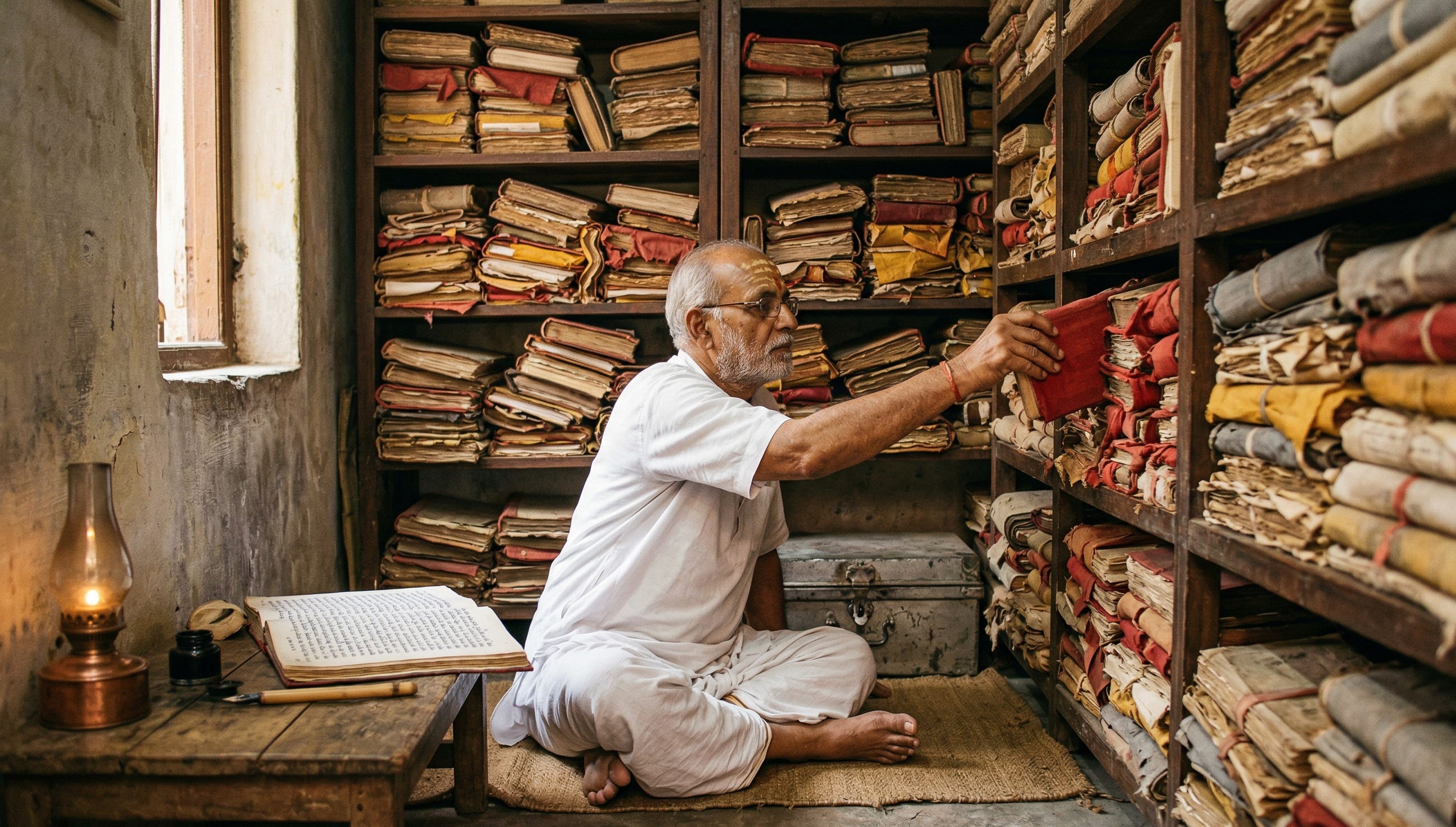
In India, at pilgrimage sites like Haridwar, there are Brahmin priests called pandas who have maintained family genealogical records for centuries. The records are called bahis: handwritten scrolls, some of them three hundred years old, classified by district and village, passed from father to son across fourteen, fifteen, sometimes twenty generations of record keepers. When a family visits, the panda retrieves the relevant scroll from a steel vault, unrolls it, traces a finger down the page, and there you are. Your name. Your parents’ names. Your grandparents’ names. Marriages, births, deaths. Written in ink on paper that’s older than anyone alive.
There is a version of this in every culture. Parish records in English churches. Birth registers in Scottish council offices. Census rolls in American county halls. The poet Thomas Gray is buried in St Giles’ churchyard in Stoke Poges, where he wrote his elegy for lives that history forgot. Somewhere, for almost everyone, there is a record. A line that connects you to the people who came before.
It doesn’t matter whether you were born in Mumbai, Dubai, Shanghai, Lagos, Kraków, or Watford General Hospital. It doesn’t matter whether your family crossed continents or whether they’ve been in the same town for ten generations and you can walk to their graves. It doesn’t matter whether you found your name in a bahi in Haridwar or a database on Ancestry.com or heard it spoken aloud by a grandmother who remembered everything.
What matters is what those records represent. Not just names. Not just lineage. But the fact that every single person listed in those scrolls, every name in every register, had one thing in common.
They hoped.
We use the word carelessly. We hope it doesn’t rain. We hope the train is on time. We hope the meeting goes well. We have stripped the word down to something small, a wish, a preference, a crossed finger.
But hope is not a wish. Hope is the most dangerous and consequential force a human being can carry. It is the decision to act as though the future might be better, despite having no proof that it will be. It is not optimism, which is a temperament. It is not faith, which is a belief. Hope is a behaviour. It is what you do when you open the textbook even though you failed the last exam. It is what you do when you apply for the job even though the last ten applications went nowhere. It is what you do when you pack a bag and walk towards a border you have never crossed, not because you know what’s on the other side, but because staying where you are has become impossible and you have decided, against all available evidence, that movement is better than stillness.
Hope is what put my family on a boat from Gujarat. Not courage. Not ambition. Hope. The irrational, unverifiable conviction that the unknown would be kinder than the known.
Here is what we miss about hope. It is not a feeling. It is a skill. Perhaps the most fundamental skill of all. Because without it, none of the others activate. Without hope, curiosity has no direction. Without hope, empathy has no purpose. Without hope, adaptability is just reaction, not growth. You don’t learn to read a room if you don’t believe the room might lead somewhere. You don’t build expertise if you don’t believe expertise will matter.
Hope is the precondition for the ladder. It is not a rung. It is the ground you stand on before you reach for the first one.
Think about what you hope for. Not what you want, which is a transaction. Not what you expect, which is a calculation. What you hope for. The answer will probably not be a salary or a job title or a qualification. It will be something more human than that. You hope your children will be safe. You hope they will have more choices than you did. You hope the work you’re doing now will mean something to someone later. You hope that the next generation inherits not just your assets but your capabilities, your judgment, the lessons you learned by getting things wrong.
That’s why you progress. Not because a training programme told you to. Not because LinkedIn told you your skills were becoming obsolete. You progress because you hope. Because the idea of standing still, of watching the world change while you remain fixed, is unbearable. Not because of ego. Because of love. You climb for the people who climbed before you and for the people who will climb after. You do it for the lineage, even if you would never use that word.
Every person who ever wrote their name in a bahi in Haridwar was performing an act of hope. So was every parent who worked a second job to pay for a child’s education. Every migrant who learned a new language at forty-five. Every person who retrained after redundancy, who started again after failure, who opened a book after being told they weren’t clever enough to read one.
Hope is what separates the people who will adapt from the people who will freeze. Not technical fluency. Not credentials. The willingness to believe that becoming more human is a viable strategy in a world that seems to be becoming less so.
We owe the generations that came before us. They had hope. They took risk. They built skills. They climbed the ladder, and in climbing it, they extended it so that we could reach higher than they did. We join our own ladder to theirs. We stand on their shoulders, whether we know their names or not. And the question we now face is whether we will do the same for the generation that follows.
The ladder is not a hierarchy. It is an inheritance. And hope is what makes the inheritance worth passing on.
You don’t need to be a migrant. You don’t need to cross continents. You don’t need to move cities. But you do need to evolve as a human. You need to lean in further to becoming even more human. That’s the change we’re facing. Not a technical upgrade. Not a new platform to learn. A wave of change that AI has brought and is still bringing, and the only adequate response is to become more of what machines cannot be.
Someone asked me recently whether AI is like the internet or like electricity. I said electricity. Because in a few years, nobody will be talking about AI. It will just be there. Invisible. Embedded in everything. The way electricity is. Nobody puts “can use electricity” on their CV. Nobody will put “AI skills” on theirs for much longer either. The skills that matter won’t be the ones you can name after a tool. They’ll be the ones you can’t.
The skills that have always been there. The curiosity. The empathy. The ability to adapt, to see the whole picture, to create something new within ethical constraint, to partner with machines without losing yourself in the process. The beggar on the street in Mumbai has them. My colleague who never left his house has them. My grandfather Cheka Cheka had them. The pandas of Haridwar, unrolling scrolls that connect the present to the deep past, have them.
The question is whether we still do.
In Mistry’s novel, the characters don’t get to climb. The system takes their hope and grinds it to powder. The talent was there. The willingness was there. The hope was there too, for a while. That’s the cruelty. It was there, and then it wasn’t.
For those of us who do have the ladder, the question is not whether we can climb. It’s whether we will.
Somewhere in Gujarat, in a room I have never visited, there may be a record with my family’s name on it. I don’t know if it’s a scroll in a temple or a register in a municipal office or a list in a cupboard that nobody has opened in years. I don’t know if the ink has faded or the paper has crumbled or if someone threw it away decades ago because nobody came to claim it. But I believe it existed, because someone, generations ago, gave their name to a person with a pen, and by doing so said: I was here. I mattered. And I hoped.
What do we have if we don’t have hope? We just have the past.
That’s the crossing. Not from one country to another. From one version of yourself to the next. The dust is settling on a world we built with specialist skills and credentials. What emerges from it will belong to those who remembered they were human first.
Would I survive on the streets of Gujarat, asking for ek paisa? I honestly don’t know.
But I have hope. And hope, it turns out, is the one coin that makes the ladder worth climbing at all.
SuperSkills: The Seven Human Skills for the Age of AI is published by Kogan Page on 3 July 2026.
Stay Curious - and don’t forget to be amazing,
PS. If your organisation is grappling with how AI is reshaping work and leadership, I speak and advise on this.
Rahim Hirji Author, SuperSkills (2026) | Keynote Speaker | Advisor
Building human capability for the AI era.
Tools I Use:
Jamie: AI Note taker without a bot. You join the meeting. The Bot doesnt.
Wispr Flow: Just dictate everything to your laptop and phone. Game Changer
Refind: AI-curated Brain Food delivered daily. Pick your intelligence.
Meco: Newsletter reader outside your inbox. Organise your intelligence.
Prompt Cowboy: Prompt Generator. Extract intelligence.
Manus: Best AI agent to do things for you. Agentise your intelligence.
Chat Hub: Multi-model intelligence
SuperSkills Intelligence: Ramp up your human intelligence
Claude Cowork: Delegate complex tasks to your friendly Claude Agent
Recommend Reading:
Now
What do an AI Agent, and Intern and a Golden retriever have in common?
Should You Leave Your Phone Charging Overnight? It used to be common wisdom that leaving your phone charging overnight degrades the battery. But handset design has evolved to mitigate the harm caused by constant charging.
A Man Let ChatGPT Sell His Home. It Beat Every Agent’s Estimate by $100K — and Closed in 5 Days. A Florida man handed pricing, listing, flyers, showings, and the contract to ChatGPT. The real estate industry is having a moment.
The Secret Lives of Six Body Doubles: ‘They Wanted Julia Roberts to Have Curvier Legs.’ Michael B. Jordan’s twin, Michael Douglas’s hands, and the woman who was Julia Roberts from the neck down. Fascinating.
Cognitive shuffling: The micro-dreaming game that helps you sleep - Invented by an academic and popularised by social media, this sleep technique has long claimed to help people switch off their busy brains. When it recently worked for me, I became curious about how exactly it plays upon the mind. Also. From childhood to midlife and beyond: how to handle anxiety at every age
Next
The Most Disruptive Company in the World - what the fight between Anthropic and the Pentagon actually means for the future
The Trillion Dollar Race to Automate Our Entire Lives - The AI sprint is hurtling toward a world where anyone can build personal concierges to do everything from executive presentations to March Madness brackets. Also: The Displacement of Cognitive Labor and What Comes After
Jensen Huang’s Vision: 75,000 Employees, 7.5 Million AI Agents — 100 AI Workers for Every Human. At Nvidia GTC, Huang also revealed engineers will receive “AI tokens” worth half their salary on top of base pay. The future of compensation is getting weird.
‘Yes, AI Is a Bubble. There Is No Question.’ Derek Thompson makes the case that AI infrastructure spending is one of the five largest CapEx bubbles in history — but that doesn’t mean the technology is useless. Nuanced, essential reading.
Thousands of People Are Selling Their Identities to Train AI — But at What Cost? Gig workers worldwide are selling their calls, texts, and moments of their lives to AI companies for quick cash. The human supply chain behind the machine.
‘Godfather of AI’ Geoffrey Hinton Says Tech Companies Aren’t Concerned with the Endgame. Hinton warns that superintelligence could arrive sooner than expected, and the companies building it are focused on short-term profits, not long-term safety. The most important voice in AI right now isn’t optimistic.
If you enjoyed this edition of Box of Amazing, please forward it to a friend or share the link on WhatsApp or LinkedIn.
Hope it’s the fundamental skill that allows humans to climb, evolve, and adapt